
You are selected to receive the Stratagems Newsletter. If you like our content, please support us by sharing and reposting on your social networks and by becoming a paid subscriber, please subscribe to Stratagems.
https://www.stratagems.info/subscription
Stratagems Newsletter Issue 8
In This Issue:
Stratagems Nexus – The Calculated Contrarian Matrix
Stratagems Acumen – Let the Tool Question the Hand
Stratagems Detours – Quick Wins
Stratagems Nexus:
The Calculated Contrarian Matrix
Download the Artifacts:
The Contrarian Hypothesis Evaluation Matrix
Every bold product strategy dies the same death: not from lack of vision, but from lack of vocabulary.
A PM proposes eliminating a feature every competitor offers. The room divides. “Customers will love this!” versus “There’s a reason everyone does it this way.” Without a framework, the decision comes down to whoever argues loudest—or the idea gets watered down.
Here’s what no one admits: being different for difference’s sake is vanity. But following every orthodoxy guarantees you’ll compete on price and features—where margins die and you’re interchangeable.
Netflix didn’t just “be different.” In 2007, they identified that customers would sacrifice instant gratification (Blockbuster’s sacred orthodoxy) IF you eliminated other frictions: late fees, limited selection, the trip to the store. They challenged one orthodoxy while addressing a sacrifice everyone normalized.
The “Uber for X” graveyards tell the opposite story. Companies challenged orthodoxies without validating customer sacrifice. Most people weren’t desperate for on-demand lawn mowing.
This is the rebellion paradox: challenge the wrong orthodoxy and you’re Don Quixote. Accept them all and you’re a commodity.
The Calculated Contrarian Matrix solves this. It plots opportunities on two dimensions: Strength of Industry Orthodoxy versus Magnitude of Customer Sacrifice.
THE SWEET SPOT (High/High): Where market-making happens. Calcified beliefs forcing meaningful compromises.
THE OBVIOUS PLAY (Low/High): Industry sees the pain. Race to execute.
THE FOOL’S ERRAND (High/Low): Customers aren’t suffering. Don’t challenge.
THE DISTRACTION (Low/Low): Innovation theater.
Basecamp built $100M occupying The Sweet Spot. Everyone believed more features = more value. Small teams drowned in complexity. Basecamp launched with fewer features and won.
The discipline: Pick orthodoxies where (1) customers make real sacrifices, (2) you can deliver alternatives, (3) timing enables challenge. Then stress test: Will customers switch? Can you execute independently? Is the orthodoxy already weakening?
Companies dominating niches didn’t follow every orthodoxy or challenge all of them. They identified where conventional wisdom is both strong and wrong—and where customer sacrifices are real and addressable.
Read the framework. Download the evaluation matrix for documenting hypotheses. Get the risk register for tracking consequences.
Sustainable differentiation doesn’t come from following crowds or rebelling blindly. It comes from knowing which beliefs to challenge.
Stratagems Acumen:
Let the Tool Question the Hand
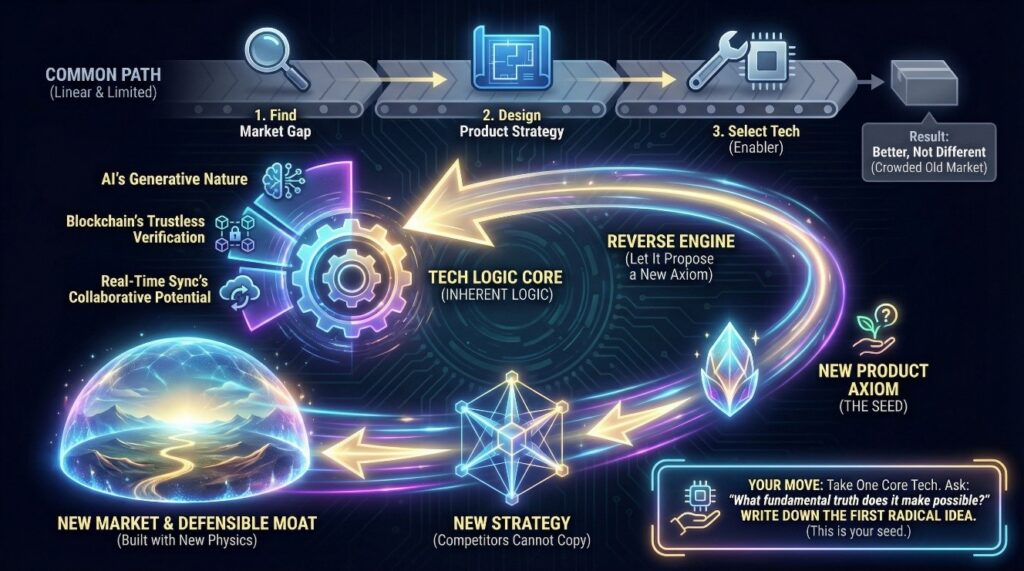
We use technology to bring our vision to life. But what if we let a technology reshape the vision itself?
The typical path is linear: identify a market gap, define a product strategy, and select the technology to enable it. This often yields better, but not different.
Now, reverse the engine. Start not with a market, but with a technology’s inherent logic—AI’s generative nature, blockchain’s trustless verification, real-time sync’s collaborative potential. Let it propose a new product axiom. This becomes the seed for a strategy that competitors, wedded to old paradigms, cannot copy. You are no longer fighting for a share in an old market; you are defining a new one.
The most defensible moat is built with new physics.
Your move: Take one core technology you use. Ask not “how does it improve our process?” but “what fundamental truth does it make possible that was previously impossible?” Write down the first radical idea. That’s your seed.
Stratagems Detours:
Quick Wins
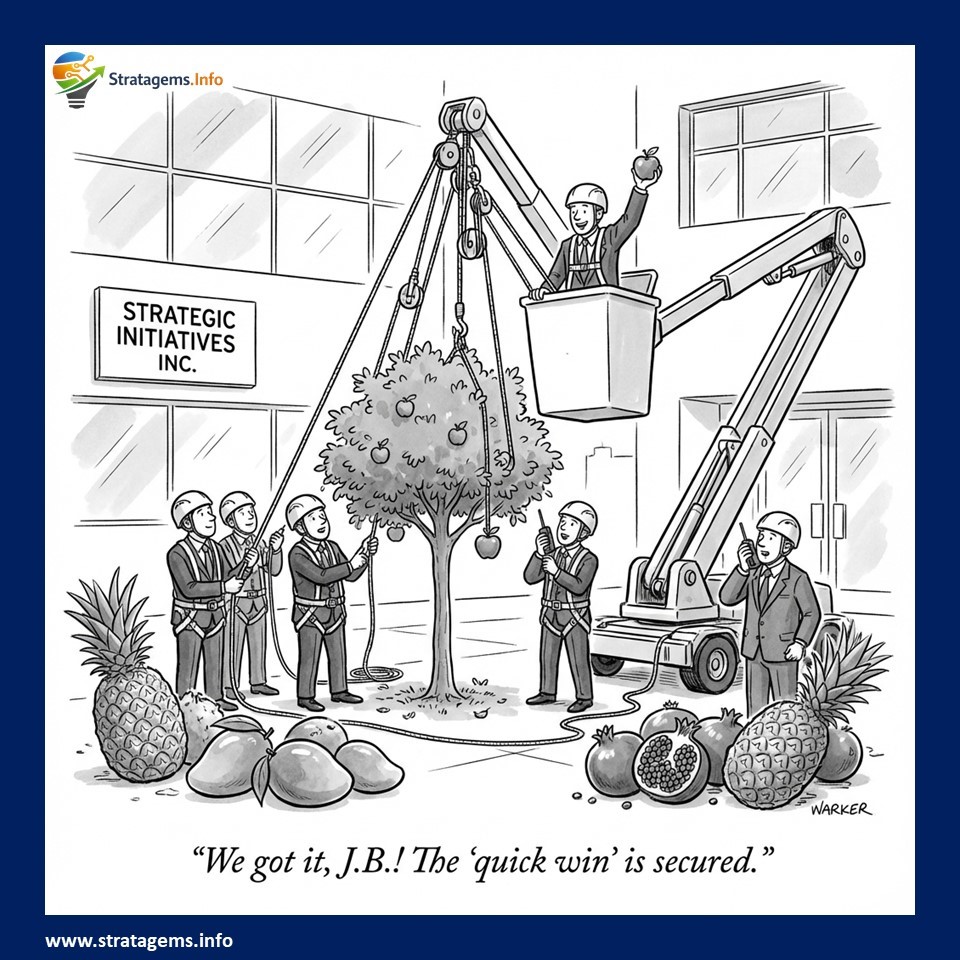
What do you think? Please share your thoughts. If you like our content, pass it on to your colleagues and share it on social media.
Know of any tips about which companies and Topics we should cover next? Send over your suggestions.