The New Calculus: When AI Stops Being a Tool and Starts Being the Compass.
For senior leaders steering the vast ships of enterprise, strategy has always been a question of direction: Which markets do we enter? What products do we build? What is our core competitive advantage? Into this venerable discipline now sails a force often mistakenly relegated to the engine room: Artificial Intelligence. The pressing, perhaps uncomfortable, question before us is no longer merely how AI can support corporate strategy, but whether it has evolved to be that corporate strategy. The answer is not a binary yes or no, but a nuanced recognition that AI is fundamentally reshaping the very architecture of value creation, turning strategy from a high-level plan into a dynamic, data-driven system.
The Historical Lens: Technology as an Enabler, Not the Architect
Traditionally, enterprise strategy has been a human-centric domain of vision, analysis, and choice. Technology—from mainframes to ERP systems to the early internet—was tactical. It automated processes, improved efficiencies, and connected supply chains. It was a powerful enabler, but the core business logic—what we sell, to whom, and why we win—remained a human construct. Think of Walmart’s legendary supply chain strategy. The technology that enabled its logistical brilliance served a clear, pre-existing strategic pillar: “everyday low prices.” The tech was brilliant, but it was an instrument, not the composer.
AI, in its initial enterprise incarnation, followed this playbook. Machine learning models optimized ad targeting, chatbots handled customer queries, and predictive maintenance kept factories humming. The strategy was set; AI just executed it better. This is what we might call AI in Strategy—a powerful, even essential, tool in the arsenal.
The Inflection Point: When Capabilities Redefine Possibility
The shift occurs when AI’s capabilities cease to be just about optimization and begin to enable entirely new value propositions, business models, and competitive moats that were previously inconceivable. This is AI as Strategy. The technology is no longer just supporting the value chain; it is fundamentally reconfiguring it and becoming the primary source of competitive advantage.
Consider the stark contrast between a traditional retailer using AI for inventory forecasting (AI in strategy) and a company like Stitch Fix. Their entire business model is predicated on a sophisticated blend of data science and human stylists. The core product—personalized apparel curation—is directly generated by their algorithms. Their strategy is their AI capability. They don’t use AI to sell clothes better; they use clothes to monetize their AI. The business cannot be separated from the algorithm.
Similarly, Netflix long ago transitioned from a content delivery network to an AI-driven ecosystem for content creation and consumption. Its famed recommendation engine, responsible for an estimated 80% of hours streamed, is not a feature; it is the core engagement mechanism. But more profoundly, its entire content strategy—what to produce, for whom, and how to market it—is driven by data and predictive models. The greenlighting of House of Cards was an early, famous example of data-informed strategy. Today, that approach is the operational norm. Their corporate strategy is an emergent property of their AI and data systems.
The New Strategic Imperatives: Data, Flywheels, and Adaptive Moats
If AI is to ascend to the level of corporate strategy, it demands a re-evaluation of strategic fundamentals.
- From Resource-Based View to Data-Based View: Traditional strategy often relies on the Resource-Based View (RBV), in which competitive advantage stems from valuable, rare, and inimitable resources. In the AI age, the paramount resource is proprietary, domain-specific data that can fuel learning systems. A company’s strategic assets are no longer just its factories and brands, but its unique datasets—John Deere’s petabytes of agricultural field data, GE’s turbine performance streams, or Airbnb’s booking and host behavior patterns. The strategy becomes about systematically acquiring, curating, and leveraging these data assets to create intelligent, defensible products and services.
- The Algorithmic Flywheel as Strategic Engine: The most powerful AI strategies create self-reinforcing feedback loops—the algorithmic flywheel. More users generate more data, which improves the AI model, which delivers a better product, which attracts more users. This is the core strategic engine of companies like Google in search and Amazon in e-commerce. Their strategy is explicitly designed to accelerate this flywheel. Any enterprise considering AI as strategy must ask: what is our proprietary flywheel, and how do we fuel it?
- Adaptive Advantage vs. Static Advantage: Traditional strategy often seeks to build a sustainable advantage—a brand, a patent, a cost structure—and then defend it. AI-centric strategy cultivates an adaptive advantage. The advantage is not in a single algorithm, but in the organization’s superior speed and skill at learning, iterating, and redeploying AI systems. It’s a meta-capability. Microsoft’s rapid integration of generative AI across its entire product suite (Copilot) exemplifies this—leveraging a foundational model (OpenAI) to inject adaptive intelligence into its established moats (Office, Windows, Azure).
The Inescapable Human Core: Orchestration, Ethics, and Vision
Declaring AI as the corporate strategy is not about advocating for autopilot. This is where nuance is critical. AI lacks judgment, purpose, and ethical reasoning. Therefore, the role of senior leadership evolves from master planners to orchestrators of intelligent systems.
- The Strategist as Architect: Leaders must architect the organizational environment—the data infrastructure, the talent mix (both technical and translational), the governance models—where AI can thrive and generate strategic insights.
- The Guardian of the “Why”: AI excels at the “how” and the “what,” but the human leader must steadfastly own the “why.” What is our purpose? What values govern our use of this technology? Navigating the ethical minefields of bias, privacy, and societal impact is a non-negotiable human strategic responsibility, as Microsoft, Google, and others have learned through public struggles with AI ethics.
- The Synthesizer: The final strategic synthesis—balancing AI-derived insights with market intuition, human empathy, and creative leaps—remains a profoundly human act. AI can simulate a million market scenarios, but the courage to choose one requires a leader.
The Path Forward: A Symbiotic Strategy
For the modern enterprise, the question is not about replacement but about fusion. The winning corporate strategy will be a symbiotic strategy—a continuous dialogue between human vision and machine intelligence.
The executive team of 2025 must therefore re-frame their approach:
- Start with the “Art of the Possible”: Instead of only asking “What are our strategic goals and how can AI help?” equally ask, “What new strategic options do our AI capabilities unlock?” Engage in exploratory dialogues with your data scientists and technologists as strategy partners, not just implementers.
- Treat Data as a Balance Sheet Asset: Audit, value, and strategically invest in your data pipelines with the same rigor applied to financial capital.
- Build for Adaptation: Design your organization for agility. This means modular tech stacks, cross-functional “fusion teams,” and a culture that tolerates intelligent experimentation and learns from algorithmic failure.
- Elevate Governance to the Board Level: AI ethics, risk, and opportunity oversight cannot be siloed in IT. It must be a core competency at the highest levels of governance.
The Central Nervous System
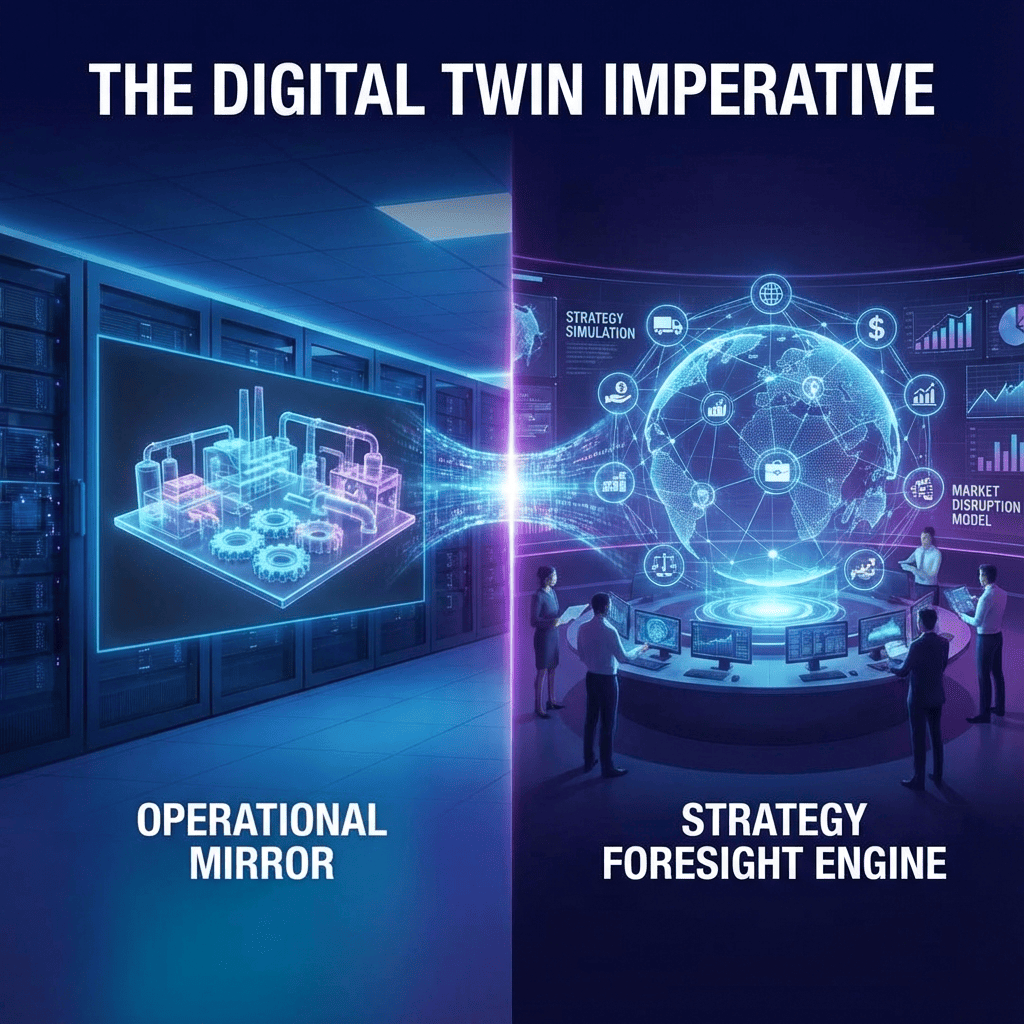
Ultimately, AI will not be the enterprise strategy in the sense of a static document. Rather, it is becoming the central nervous system of the strategy. It provides real-time sensing, predictive analytics, and operational automation, enabling a corporate strategy to be dynamic, precise, and resilient. The role of the senior leader is not to cede control to the algorithm, but to imbue it with purpose and context—to provide the wisdom that turns data into direction.
The enterprise that views AI merely as a tool in its strategic toolkit is preparing for yesterday’s battle. The enterprise that recognizes AI as the new calculus of competition—the very language in which strategy is formulated, tested, and executed—is building for a future where intelligence is the ultimate, and perhaps only, sustainable advantage. The strategy is no longer just about having AI; it is about being, intelligently.