Technology Strategy

Category: Technology Strategy

The Applied Tech Radar: Filtering Hype for Strategic Implementation

Salesforce spent $27.7 billion acquiring Slack in 2021. Within 18 months, they’d written down hundreds of millions of dollars in value. Not because Slack was bad technology, it wasn’t. But because the strategic thesis (“we need to own workplace collaboration”) ignored a fundamental question: Does this technology solve a problem our customers actually have, or a problem we think they should have?

This pattern repeats across industries with numbing regularity. Retail giants pour resources into metaverse stores while their e-commerce checkout flow hemorrhages conversions. Banks launch blockchain pilots while their core banking systems can’t handle real-time fraud detection. Manufacturers pursue digital twin implementations even as their production lines still rely on clipboards.

The issue isn’t technological ignorance. Most large enterprises have CTOs who understand the tech stack. The problem is strategic blindness—the inability to separate signal from noise when emerging technologies arrive wrapped in billion-dollar valuations and breathless press coverage. Leaders know they can’t ignore innovation. But they also can’t chase every shiny object. What they lack is a systematic framework for deciding which emerging technologies deserve resources and which deserve polite disinterest.

Download the Artifacts:

Applied Tech Radar Scoring Tool

Evaluate any tech in 15 minutes with auto-calculated radar

Tech Discard Log Template

Tech Discard Log: Strategic Technology Deprioritization Documentation Purpose &

The Applied Tech Radar System: From Hype to Strategic Clarity

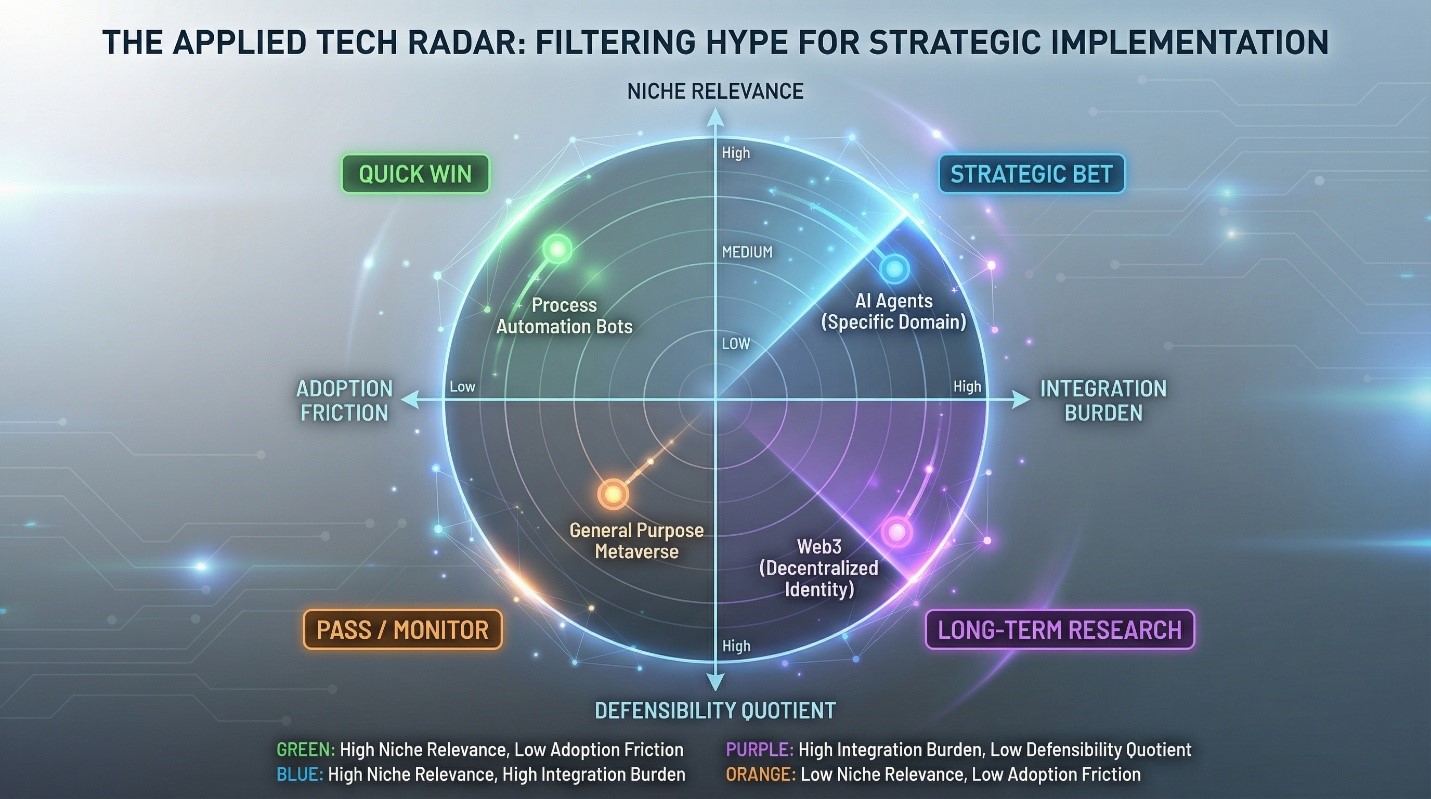
The Applied Tech Radar operates on two axes that cut through the fog of tech evangelism. The vertical axis measures Market Maturity versus Your Timing—the gap between when a technology becomes broadly viable and when your specific segment actually needs it. The horizontal axis tracks Strategic Fit versus Tactical Noise—whether this technology addresses a core constraint in your business model or merely automates a peripheral process.

These axes create four distinct quadrants, each demanding a radically different response.

Quadrant I: Strategic Accelerators (High Fit, Right Timing) This is where competitive advantage lives. Technologies here directly address your current strategic constraints, and the market infrastructure supports adoption. When Walmart implemented computer vision systems for inventory management in 2019, they weren’t chasing hype. They were solving a $3 billion shrinkage problem with technology that had finally matured beyond the research lab and into reliable, scalable deployment.

The signature of a Strategic Accelerator: it makes an existing capability dramatically better or cheaper, not hypothetically different. Netflix’s shift to AWS in the early 2010s wasn’t visionary futurism. It was recognizing that cloud infrastructure had matured to the point where they could scale streaming capacity faster and more cheaply than by building data centers. The technology matched their immediate constraint—unpredictable demand spikes—and the market timing was right.

Quadrant II: Premature Optimization (High Fit, Wrong Timing) These technologies will matter to your business—just not yet. The infrastructure isn’t ready. The talent pool is too thin. The vendor ecosystem is immature. Moving too early burns capital and organizational credibility.

Consider autonomous delivery vehicles. For logistics companies, the strategic fit is obvious: labor represents 50-60% of last-mile delivery costs. But in 2024, despite a decade of pilots, autonomous delivery remains trapped in geo-fenced experiments. Regulatory frameworks are incomplete. Edge cases—such as snow, construction, and aggressive drivers—still require human intervention. FedEx and UPS maintain pilot programs, but they’re not betting the farm on them. They’re maintaining optionality while the technology matures. That’s the correct response to Premature Optimization: watch closely, experiment cheaply, but don’t commit core resources.

Quadrant III: Tactical Enhancements (Low Fit, Right Timing). These technologies work. They’re readily available. They just don’t move your strategic needle. Adopting them won’t hurt you, the ROI might even be positive—but they won’t create differentiation. They’re process improvements, not transformations.

Robotic process automation is a good fit for most enterprises. It can automate repetitive back-office tasks with proven reliability. But it doesn’t change your competitive position. Your rivals have access to the same tools from the same vendors. The value is operational efficiency, not strategic advantage. Treat these technologies as you would any IT upgrade: evaluate ROI, implement if justified, move on. Don’t confuse them with strategic priorities.

Quadrant IV: Distraction Zone (Low Fit, Wrong Timing) This is where organizational discipline dies. These are technologies that generate enormous press coverage but have neither strategic relevance to your business nor sufficient market maturity to support reliable implementation. Yet they consume board meeting time and executive attention because someone asked, “What’s our Web3 strategy?”

The distraction zone is where most innovation theater happens. When Walmart and Disney announced metaverse initiatives in 2021-2022, they joined dozens of Fortune 500 companies in chasing a technology with no clear path to revenue in their core businesses. By late 2023, most had quietly shelved these projects. Not because the metaverse will never matter—it might—but because in 2024, for retail and entertainment companies, it solves no pressing constraint and the technology remains embryonic for mass-market applications.

Applying the Radar: Two Technologies, Radically Different Implications

Let’s test the framework against two technologies dominating current discourse: generative AI and blockchain-based supply chain tracking.

Generative AI: Location Determines Strategy

For a B2B software company selling to creative agencies, generative AI sits squarely in Quadrant I: Strategic Accelerator. The technology is production-ready. Major platforms (OpenAI, Anthropic, Google) offer stable APIs. The strategic fit is direct: their customers use these tools daily for content creation, and integration into existing products creates immediate differentiation. Canva’s integration of AI image generation didn’t require them to evangelize the technology—their users were already familiar with DALL-E and Midjourney. Canva just made it seamless within their workflow.

For a commercial real estate company, the same technology lands in Quadrant III: Tactical Enhancement. They might use AI to draft property descriptions or generate market reports. Useful? Sure. Strategic? No. Their competitive advantage rests on deal flow, relationships, and market knowledge—none of which AI fundamentally transforms. Implementing it is a reasonable productivity play, not a strategic imperative.

For a pharmaceutical manufacturer, generative AI is Quadrant II: Premature Optimization. The potential strategic fit is enormous—AI could accelerate drug discovery, predict protein folding, and optimize clinical trials. But in 2024, regulatory frameworks remain unclear. Liability for AI-generated research insights is undefined. The talent required to deploy these systems safely in regulated environments is scarce. Pfizer and Moderna maintain research partnerships, but they’re not restructuring R&D around AI outputs. They’re positioning for when the technology and its surrounding ecosystem mature.

Blockchain Supply Chain: Mostly Distraction

For most enterprises, blockchain-based supply chain tracking remains in Quadrant IV: Distraction Zone. The technology works—Walmart and Maersk have functional implementations. But ask the hard question: what problem does it solve that existing databases and EDI systems don’t?

The typical pitch: “Blockchain creates an immutable, transparent record of product movement.” True. But immutability only matters if you don’t trust your partners. For most supply chains, the problem isn’t participants lying about shipment data. It’s participants using incompatible systems, not sharing data due to competitive concerns, or making errors in manual data entry. Blockchain doesn’t fix those problems. Shared databases with API integrations do—and they’re vastly simpler and cheaper.

The exception: industries with genuine trust deficits and regulatory requirements for provenance. Diamond tracking through the Kimberley Process leverages blockchain’s immutability to create real value, as the entire system is designed to prevent conflict diamonds from entering legitimate supply chains. The technology maps to a specific, high-stakes trust problem. That moves it to Quadrant I for that specific use case.

For everyone else, the blockchain supply chain remains a solution seeking a problem—often implemented to signal innovation rather than solve constraints.

The Implementation Playbook: What to Do in Each Quadrant

Quadrant I – Strategic Accelerators: Move Fast. When a technology lands here, speed matters. Your competitors see the same opportunity. Build a 90-day implementation sprint. Assign your best product and engineering talent. Create direct executive ownership—not a committee. Accept that the first iterations will be imperfect. The goal is shipping a version that captures 60% of the value in three months, not engineering perfection in eighteen.

Warning sign: If you’re still conducting feasibility studies on a Strategic Accelerator technology six months after identifying it, you’ve already lost ground.

Quadrant II – Premature Optimization: Build Optionality. Don’t ignore these technologies. Don’t bet on them either. Instead:

  • Maintain small, dedicated research teams that track developments
  • Run time-boxed experiments with fixed budgets
  • Develop relationships with leading vendors before they’re mainstream
  • Train a core team so you can scale quickly when timing shifts

The mistake is either pretending the technology doesn’t exist or committing major resources before the ecosystem matures. Both extremes are wrong. The right response is disciplined observation with limited downside exposure.

Quadrant III – Tactical Enhancements: Standard IT Evaluation. Apply conventional ROI analysis. If the payback period is acceptable and the implementation risk is low, proceed. If not, skip it. Don’t dress these up as strategic initiatives. They’re operational improvements. Treat them as such.

Critical rule: Never let tactical enhancements consume strategic resources. A common failure pattern: the organization pours energy into implementing RPA across departments while a true Strategic Accelerator technology languishes in a pilot program because “we’re focused on automation right now.” That’s exactly backward.

Quadrant IV – Distraction Zone: Aggressive Filtering. This requires organizational courage. When board members ask about the company’s metaverse strategy, the correct answer might be: “We’ve evaluated it. It’s not strategically relevant to our business in the next three years. We’re monitoring developments, but we’re not allocating resources beyond that.”

Create a formal review process for technologies in this quadrant. Evaluate them annually—not quarterly. Resist the pressure to “do something” just to have a slide deck for the next board meeting.

The Dynamic Radar: Technologies Move Between Quadrants

A static assessment is worthless. Technologies migrate across quadrants as markets, and your business evolves.

Cloud computing moved from Quadrant II to Quadrant I for most enterprises between 2008 and 2012. In 2008, the technology worked, but the vendor ecosystem was thin, security concerns were unresolved, and enterprise-grade SLAs didn’t exist. By 2012, AWS had proven reliability at scale, a robust partner network had emerged, and the cost advantages were undeniable. Companies that moved in 2009 overpaid for risk. Companies that waited until 2014 overpaid in lost efficiency.

Your job is recognizing inflection points. Set triggers for re-evaluation:

  • Regulatory clarity emerges or disappears
  • Dominant vendors achieve certain adoption milestones
  • Your strategic constraints shift due to market changes
  • Adjacent technologies mature and create compound opportunities

Amazon’s acquisition of Kiva Systems (warehouse robotics) in 2012 for $775 million looked like Quadrant II—right fit, early timing. But Amazon correctly predicted that e-commerce growth would create warehouse labor constraints faster than competitors anticipated. By the time rivals like Walmart realized robotics had shifted to Quadrant I, Amazon had a six-year head start and had stopped selling Kiva systems externally. The timing assessment was aggressive but correct.

The Organizational Discipline to Execute This Framework

Knowing the quadrants is easy. Acting on them is hard because organizations have structural antibodies against this kind of clarity.

Innovation teams are incentivized to pursue novelty. They pitch Quadrant IV technologies because they’re exciting and generate conference speaking opportunities. Business units advocate for Quadrant III technologies because they make their operational lives easier. Meanwhile, Quadrant I opportunities sit in pilot purgatory because they require cross-functional coordination and executive risk-taking.

You need forcing mechanisms:

Annual Technology Portfolio Review: Once per year, map every significant technology initiative to the quadrant framework. Kill everything in Quadrant IV that’s consuming more than monitoring-level resources. Accelerate everything in Quadrant I. This sounds obvious. In practice, it requires overcoming departmental politics and sunk-cost fallacies.

Explicit Resource Allocation: Declare that 70% of innovation resources go to Quadrant I, 20% to Quadrant II, 10% to Quadrant III, and 0% to Quadrant IV beyond monitoring. Force teams to defend why their project deserves its quadrant classification. The conversation that emerges—”Why do you believe this is Strategic Accelerator versus Premature Optimization?”—is more valuable than the final classification.

Executive Ownership of Quadrant I: Strategic Accelerators don’t belong in innovation labs. They belong on executive scorecards. If a technology genuinely moves your strategic needle and the timing is right, the CEO or business unit president should own the outcome. Innovation theater happens when transformational technologies are delegated to people without P&L authority.

The Contrarian Truth: Most Technologies Don’t Matter to Most Companies

Here’s what this framework reveals: for any given company, at any given time, most emerging technologies are genuinely irrelevant. This isn’t defeatism or conservatism. It’s strategic focus.

The tyranny of tech media is the implicit assumption that every technology matters to every company. It doesn’t. Web3 might be transformational for digital identity systems. It’s probably irrelevant to industrial manufacturing. Computer vision is strategic for autonomous vehicles. It’s tactical for retail analytics. Generative AI rewrites content creation. It barely touches commercial construction.

The competitive advantage doesn’t come from adopting every technology. It comes from adopting the right technologies with the right timing and ignoring the rest with disciplined indifference.

When Microsoft’s Satya Nadella bet the company’s future on cloud and AI while de-emphasizing consumer hardware, he wasn’t hedging. He was making an explicit quadrant assessment: Azure and AI tools were Strategic Accelerators for Microsoft’s enterprise business. Consumer devices were, at best, Tactical Enhancements. He concentrated resources accordingly. The result: Microsoft’s market cap grew from $300 billion in 2014 to over $3 trillion in 2024.

That clarity—knowing what not to do as clearly as what to do—is the framework’s ultimate value. It transforms the question from “What’s our strategy for this technology?” to “Does this technology deserve a strategy?”

Most of the time, the answer is no. And that’s exactly right.

Sources & Further Reading:

  1. Walmart Annual Reports (2019-2023), detailing computer vision implementation and shrinkage reduction metrics
  2. “The Everything Store” by Brad Stone – Netflix AWS migration case study and strategic decision-making process
  3. McKinsey & Company, “Blockchain beyond the hype: What is the strategic business value?” (2023)
  4. Gartner Hype Cycle for Emerging Technologies (2020-2024), tracking technology maturity and adoption curves
  5. Harvard Business Review, “Why So Many High-Profile Digital Transformations Fail” (2023), analyzing enterprise technology adoption patterns.

Category: Technology Strategy

Edge-as-Strategy: The Coming Inversion of Cloud Economics.

The most profound shift in enterprise technology since the rise of cloud computing is happening not in data centers but in parking lots, factory floors, and retail stores. After two decades of centralizing compute power in distant clouds, the strategic advantage is flowing back to the edge—to the physical locations where business actually happens. The companies building dominance at these edge locations are discovering something counterintuitive: owning the edge doesn’t require owning the infrastructure.

This isn’t a technology story. It’s a strategy story about where value accumulates when the constraints change. And the constraints are changing dramatically.

The Cloud Centralization Trap

The cloud revolution succeeded by solving a capital allocation problem. Instead of buying servers that sat idle 80% of the time, companies could rent compute capacity on demand. Amazon Web Services turned this into a $90 billion business by 2023, followed closely by Microsoft Azure and Google Cloud. The strategic playbook became clear: centralize data, centralize compute, and deliver services through APIs and applications.

But centralization created new constraints. Real-time decision-making suffers when data must travel hundreds of miles to a cloud data center and back. A self-driving delivery vehicle can’t wait 100 milliseconds for the cloud to decide whether that’s a pedestrian or a shopping cart. A manufacturing line can’t tolerate network latency when coordinating robotic arms moving at industrial speeds. Retail systems can’t afford the degradation in customer experience when payment processing depends on consistent connectivity to remote servers.

These aren’t edge cases—they’re the core use cases driving the next decade of business value. Boston Consulting Group estimates that by 2025, 75% of enterprise-generated data will be created and processed outside traditional data centers, up from less than 20% in 2020. The question isn’t whether compute will move to the edge. The question is who will control it.

The New Edge Battleground

The strategic edge isn’t defined by technology topology—it’s defined by proximity to business-critical decisions. Three domains are emerging as the primary battlegrounds.

The Retail Edge is where consumer intent meets inventory reality. Walmart operates over 10,500 stores in the United States alone, each one a potential edge computing node. The company has invested heavily in edge infrastructure that enables real-time price optimization, predictive inventory management, and checkout-free shopping experiences. But Walmart’s edge strategy isn’t about deploying servers—it’s about deploying intelligence at the moment of customer interaction.

Consider Amazon’s Just Walk Out technology, which the company has now deployed in dozens of stores and licensed to other retailers. The system processes computer vision and sensor data locally to track what customers pick up, eliminating checkout lines entirely. This only works because the compute happens at the edge—in the store—where latency is measured in milliseconds and network dependencies are minimized. Amazon isn’t selling cloud services here; it’s selling edge orchestration as a service.

The Industrial Edge is where physical operations generate value. Siemens reports that manufacturers deploying edge computing for predictive maintenance have reduced unplanned downtime by 30-50%. But the real strategic insight isn’t the technology—it’s the business model. Siemens doesn’t require manufacturers to buy and operate edge infrastructure. Instead, the company provides MindSphere, an industrial IoT platform that orchestrates edge compute resources wherever the customer needs them: on machinery, in control rooms, or in micro data centers on the factory floor.

The financial model is revealing. Siemens customers pay for outcomes—reduced downtime, improved throughput, energy savings—not for servers. The capital expenditure shifts from the manufacturer to Siemens, while the value capture shifts based on measured business results. This is edge-as-strategy, not edge-as-infrastructure.

The Logistics Edge is where delivery meets destination. FedEx operates approximately 5,000 retail locations and 700 distribution centers globally, but its real edge is the 200,000 vehicles in motion at any given moment. Each vehicle is a mobile edge node capable of route optimization, package tracking, and delivery orchestration without constant cloud connectivity.

What makes this strategic rather than operational is how it changes competitive dynamics. When UPS deployed edge computing to its delivery vehicles in 2012 through its ORION system, the company initially saved 100 million miles annually—translating to roughly $300-400 million in annual savings. But the deeper advantage emerged over time: the data generated at the edge created a proprietary routing intelligence that competitors couldn’t easily replicate. The edge became a moat.

The CapEx-Light Edge Model

The conventional wisdom suggests that controlling the edge requires massive capital investment in distributed infrastructure. Install servers in thousands of locations. Deploy networking equipment. Hire technical staff to maintain it all. This is the trap that prevents most companies from pursuing edge strategies.

But the emerging winners are proving otherwise. They’re building edge dominance through three CapEx-light mechanisms that separate infrastructure ownership from strategic control.

Embedded Partnership Models place compute capability directly into third-party assets. NVIDIA’s Jetson platform, which powers edge AI applications, doesn’t require NVIDIA to own factories or delivery vehicles. Instead, the company embeds its edge computing modules into partners’ physical infrastructure—manufacturing equipment from Fanuc, autonomous vehicles from TuSimple, retail systems from NCR. NVIDIA captures value through the intelligence layer, not the infrastructure layer.

The financial elegance is striking. NVIDIA’s partners bear the capital cost of deploying edge infrastructure. NVIDIA provides the silicon and software that makes that infrastructure intelligent. As the platform becomes more valuable, partners become more locked in—not through contracts, but through accumulated data, trained models, and operational dependencies. The CapEx sits on someone else’s balance sheet while the strategic control sits with NVIDIA.

Infrastructure-as-a-Service at the Edge extends the cloud economic model to distributed locations. Vapor IO operates edge data centers in cell tower locations across major cities, but customers don’t lease space or buy servers. They deploy applications into Vapor IO’s infrastructure, which sits within five to ten milliseconds of end users. The company raised $90 million to build this infrastructure—capital that customers don’t have to deploy themselves.

The strategic insight is that infrastructure proximity creates competitive advantage only when paired with the right applications. Vapor IO provides the proximity; customers provide the applications; value accrues to whoever captures the customer relationship and the resulting data. Startups can deploy edge applications in dozens of cities without building dozens of edge data centers.

Edge Orchestration Platforms treat physical locations as heterogeneous resources to be managed centrally. Google’s Anthos and Amazon’s Outposts represent the cloud giants’ recognition that edge control matters more than edge ownership. These platforms let enterprises run workloads across their own data centers, retail locations, factory floors, and public cloud resources through a single control plane.

But the more interesting model comes from companies like Couchbase, which provide distributed databases designed specifically for edge scenarios. Retail chains use Couchbase to run point-of-sale systems that continue to function during network outages, syncing with central systems when connectivity returns. The capital investment isn’t in edge servers—it’s in software that makes any server at the edge strategically useful. Couchbase grew to a $1.6 billion valuation by enabling edge strategies, not by funding them.

Strategic Implications for Enterprise Leaders

The shift to edge-as-strategy creates both opportunities and risks that executives must navigate carefully. The first-order effect is operational—reduced latency, improved reliability, better customer experiences. But the second-order effects reshape competitive dynamics in ways that demand strategic attention.

Data gravity shifts from centralized to distributed. When compute happens at the edge, data is generated and often processed locally. This fragments the unified data lake that many enterprises have spent the last decade building. The strategic question becomes: where should data reside to maximize its value?

Starbucks resolved this by treating each store as a data-generating point while centralizing the learning. Individual stores don’t need access to global sales patterns, but the global analytics team needs access to aggregated store data. The company uses edge computing to process transaction data locally while selectively transmitting insights to central systems. The result is a distributed data strategy that keeps latency low and storage costs contained while preserving enterprise-wide intelligence.

Platform power concentrates at the edge orchestration layer. In the cloud era, AWS, Azure, and Google Cloud captured enormous value by controlling the infrastructure layer. In the edge era, value will concentrate among companies that control how distributed resources get orchestrated, regardless of who owns them.

This creates an opening for new platform players. Cloudflare, historically known for content delivery, now positions itself as an edge computing platform with over 275 data centers worldwide. Developers can deploy applications to Cloudflare’s edge without managing infrastructure, paying only for compute time used. The company went public at a $5 billion valuation and has grown to over $10 billion by 2024—not by selling bandwidth, but by selling edge orchestration.

Switching costs shift from data lock-in to operational dependencies. Moving data between cloud providers remains difficult, but moving edge deployments is harder still. When your intelligence is embedded in physical locations—retail stores, factory equipment, delivery vehicles—changing platforms means changing operational workflows that directly touch customers, products, and revenue.

This has profound implications for vendor selection. The edge platform you choose today will be harder to replace than your cloud provider, because it becomes integrated into your daily operations. Executives should evaluate edge partnerships with the same rigor they apply to ERP selection: assume a ten-year relationship and choose accordingly.

The Unicorn Blueprint

The next generation of billion-dollar companies will be built on edge-as-strategy principles, but not by replicating the cloud giants’ infrastructure-heavy model. The pattern emerging from early winners points to a specific playbook.

Start with an edge-native use case where cloud centralization fails. Autonomous vehicle company Waymo didn’t begin by building cloud infrastructure—it began with a problem that demands edge computing: vehicles making split-second decisions with or without network connectivity. The edge requirement drove the architecture, not the other way around.

Build the orchestration layer, not the infrastructure layer. Samsara, which provides IoT solutions for physical operations, reached a $5 billion valuation without building factories or buying delivery fleets. The company provides sensors, cameras, and edge-compute capabilities that customers deploy into their existing physical infrastructure. Samsara’s value is in connecting and orchestrating these distributed resources, not in owning them.

Capture proprietary data at the point of creation. When intelligence processes at the edge, the company controlling that intelligence captures first access to the data. Toast, the restaurant point-of-sale system, processes every order at the edge—in the restaurant—giving the company unprecedented visibility into dining patterns, menu performance, and operational efficiency. Toast went public in 2021 at a $20 billion valuation, not by owning restaurants, but by owning the intelligence layer where dining transactions happen.

Design for graceful degradation, not perfect connectivity. Edge-native companies assume intermittent connectivity and design accordingly. Square’s point-of-sale system processes credit card transactions at the edge and syncs with the cloud when possible. This architectural decision—treating edge compute as primary and cloud as supplementary—reverses the traditional model and creates a more resilient customer experience.

Layer edge capabilities with central intelligence. The most successful edge strategies maintain a central intelligence layer that learns from distributed edge deployments. Ocado, the online grocery company, uses edge computing in its automated warehouses to coordinate thousands of robots in real-time. But the central intelligence layer continuously optimizes routing algorithms based on aggregate performance data from all warehouses. The edge provides speed; the center provides learning.

Risk Factors and Implementation Traps

Moving to edge-as-strategy introduces risks that centralized cloud deployments largely avoid. Security surfaces multiply as compute is distributed across hundreds or thousands of locations. Each edge node becomes a potential vulnerability, especially when located in unsecured retail environments or on mobile assets such as delivery vehicles.

The strategic response isn’t to avoid edge computing—it’s to architect differently. Zero-trust security models, where every request is authenticated regardless of location, become essential. Companies like Zscaler have built multi-billion-dollar businesses by providing security architectures designed specifically for distributed compute environments.

Governance complexity scales with physical distribution. When data is processed in multiple jurisdictions, regulatory compliance requirements multiply. European stores must comply with GDPR. California locations must comply with CCPA. Healthcare facilities must meet HIPAA requirements. Centralized cloud deployments simplify compliance by consolidating data in known locations. Edge deployments fragment compliance obligations across every physical location.

The solution isn’t technical—it’s operational. Companies successfully deploying edge strategies build compliance into the orchestration layer. Data residency rules, retention policies, and access controls are enforced centrally but executed locally. This requires legal, compliance, and technology teams to collaborate more closely than traditional cloud deployments demand.

Integration complexity increases when edge systems must interoperate with centralized enterprise systems. ERP, CRM, and supply chain systems typically assume centralized data models. Edge deployments create distributed data models that must be synced with central systems without causing conflicts or data quality issues.

The companies navigating this successfully treat synchronization as a first-class design problem, not an afterthought. They build explicit reconciliation logic that resolves conflicts, handles out-of-order updates, and maintains data consistency across distributed and centralized systems. This requires more sophisticated data architecture than cloud-only deployments, but it’s essential for edge strategies to deliver their promised value.

The Strategic Horizon

The edge-as-strategy shift will reshape industry structures in ways that parallel how cloud computing reshaped software. Just as SaaS companies displaced on-premise software vendors by changing the capital model, edge-native companies will displace cloud-native incumbents by changing the latency model.

Retail will see continued consolidation between physical presence and digital intelligence. Companies that master edge computing in stores will deliver shopping experiences that pure e-commerce players cannot match—immediate inventory verification, instant price matching, checkout-free convenience. The retailer with the best edge orchestration, not the biggest cloud infrastructure, will win.

Manufacturing will fragment between companies that treat factories as cost centers and those that treat them as intelligence centers. The latter will deploy edge computing across every piece of equipment, creating operational intelligence that optimizes in real time rather than in batch. The productivity gap between edge-native and cloud-dependent manufacturers will widen until it becomes a competitive chasm.

Logistics will stratify between companies that track shipments and companies that orchestrate them. The former treats packages as passive objects moving through a network. The latter treats every vehicle, every package, and every delivery location as an active participant in a distributed intelligence system. The customer experience difference—predictive delivery windows, dynamic rerouting, proactive exception handling—will become the basis for pricing power.

The executives who recognize this shift early will ask different questions than their peers. Not “Should we deploy edge computing?” but “Where in our physical operations would local intelligence create disproportionate value?” Not “How much will edge infrastructure cost?” but “Who can provide edge orchestration without requiring capital deployment?” Not “What edge technology should we buy?” but “What edge platform should we build on?”

The answers to these questions will determine which companies build the next generation of competitive moats and which companies watch their cloud-era advantages erode. The edge is coming. The question is whether you’ll own it through capital or through strategy.

For executives evaluating edge strategies, three actions warrant immediate attention: First, map your physical operational footprint—stores, factories, vehicles, equipment—and identify where local decision-making latency currently constrains business value. Second, evaluate edge orchestration platforms that can deploy intelligence to those locations without requiring capital investment in infrastructure. Third, design data governance models that support distributed data generation while maintaining centralized learning and compliance. The companies that move decisively on these three dimensions will be positioned to capture value as the edge reshapes industry economics.

Category: Technology Strategy

The New Calculus: When AI Stops Being a Tool and Starts Being the Compass.

For senior leaders steering the vast ships of enterprise, strategy has always been a question of direction: Which markets do we enter? What products do we build? What is our core competitive advantage? Into this venerable discipline now sails a force often mistakenly relegated to the engine room: Artificial Intelligence. The pressing, perhaps uncomfortable, question before us is no longer merely how AI can support corporate strategy, but whether it has evolved to be that corporate strategy. The answer is not a binary yes or no, but a nuanced recognition that AI is fundamentally reshaping the very architecture of value creation, turning strategy from a high-level plan into a dynamic, data-driven system.

The Historical Lens: Technology as an Enabler, Not the Architect

Traditionally, enterprise strategy has been a human-centric domain of vision, analysis, and choice. Technology—from mainframes to ERP systems to the early internet—was tactical. It automated processes, improved efficiencies, and connected supply chains. It was a powerful enabler, but the core business logic—what we sell, to whom, and why we win—remained a human construct. Think of Walmart’s legendary supply chain strategy. The technology that enabled its logistical brilliance served a clear, pre-existing strategic pillar: “everyday low prices.” The tech was brilliant, but it was an instrument, not the composer.

AI, in its initial enterprise incarnation, followed this playbook. Machine learning models optimized ad targeting, chatbots handled customer queries, and predictive maintenance kept factories humming. The strategy was set; AI just executed it better. This is what we might call AI in Strategy—a powerful, even essential, tool in the arsenal.

The Inflection Point: When Capabilities Redefine Possibility

The shift occurs when AI’s capabilities cease to be just about optimization and begin to enable entirely new value propositions, business models, and competitive moats that were previously inconceivable. This is AI as Strategy. The technology is no longer just supporting the value chain; it is fundamentally reconfiguring it and becoming the primary source of competitive advantage.

Consider the stark contrast between a traditional retailer using AI for inventory forecasting (AI in strategy) and a company like Stitch Fix. Their entire business model is predicated on a sophisticated blend of data science and human stylists. The core product—personalized apparel curation—is directly generated by their algorithms. Their strategy is their AI capability. They don’t use AI to sell clothes better; they use clothes to monetize their AI. The business cannot be separated from the algorithm.

Similarly, Netflix long ago transitioned from a content delivery network to an AI-driven ecosystem for content creation and consumption. Its famed recommendation engine, responsible for an estimated 80% of hours streamed, is not a feature; it is the core engagement mechanism. But more profoundly, its entire content strategy—what to produce, for whom, and how to market it—is driven by data and predictive models. The greenlighting of House of Cards was an early, famous example of data-informed strategy. Today, that approach is the operational norm. Their corporate strategy is an emergent property of their AI and data systems.

The New Strategic Imperatives: Data, Flywheels, and Adaptive Moats

If AI is to ascend to the level of corporate strategy, it demands a re-evaluation of strategic fundamentals.

  1. From Resource-Based View to Data-Based View: Traditional strategy often relies on the Resource-Based View (RBV), in which competitive advantage stems from valuable, rare, and inimitable resources. In the AI age, the paramount resource is proprietary, domain-specific data that can fuel learning systems. A company’s strategic assets are no longer just its factories and brands, but its unique datasets—John Deere’s petabytes of agricultural field data, GE’s turbine performance streams, or Airbnb’s booking and host behavior patterns. The strategy becomes about systematically acquiring, curating, and leveraging these data assets to create intelligent, defensible products and services.
  2. The Algorithmic Flywheel as Strategic Engine: The most powerful AI strategies create self-reinforcing feedback loops—the algorithmic flywheel. More users generate more data, which improves the AI model, which delivers a better product, which attracts more users. This is the core strategic engine of companies like Google in search and Amazon in e-commerce. Their strategy is explicitly designed to accelerate this flywheel. Any enterprise considering AI as strategy must ask: what is our proprietary flywheel, and how do we fuel it?
  3. Adaptive Advantage vs. Static Advantage: Traditional strategy often seeks to build a sustainable advantage—a brand, a patent, a cost structure—and then defend it. AI-centric strategy cultivates an adaptive advantage. The advantage is not in a single algorithm, but in the organization’s superior speed and skill at learning, iterating, and redeploying AI systems. It’s a meta-capability. Microsoft’s rapid integration of generative AI across its entire product suite (Copilot) exemplifies this—leveraging a foundational model (OpenAI) to inject adaptive intelligence into its established moats (Office, Windows, Azure).

The Inescapable Human Core: Orchestration, Ethics, and Vision

Declaring AI as the corporate strategy is not about advocating for autopilot. This is where nuance is critical. AI lacks judgment, purpose, and ethical reasoning. Therefore, the role of senior leadership evolves from master planners to orchestrators of intelligent systems.

  • The Strategist as Architect: Leaders must architect the organizational environment—the data infrastructure, the talent mix (both technical and translational), the governance models—where AI can thrive and generate strategic insights.
  • The Guardian of the “Why”: AI excels at the “how” and the “what,” but the human leader must steadfastly own the “why.” What is our purpose? What values govern our use of this technology? Navigating the ethical minefields of bias, privacy, and societal impact is a non-negotiable human strategic responsibility, as Microsoft, Google, and others have learned through public struggles with AI ethics.
  • The Synthesizer: The final strategic synthesis—balancing AI-derived insights with market intuition, human empathy, and creative leaps—remains a profoundly human act. AI can simulate a million market scenarios, but the courage to choose one requires a leader.

The Path Forward: A Symbiotic Strategy

For the modern enterprise, the question is not about replacement but about fusion. The winning corporate strategy will be a symbiotic strategy—a continuous dialogue between human vision and machine intelligence.

The executive team of 2025 must therefore re-frame their approach:

  1. Start with the “Art of the Possible”: Instead of only asking “What are our strategic goals and how can AI help?” equally ask, “What new strategic options do our AI capabilities unlock?” Engage in exploratory dialogues with your data scientists and technologists as strategy partners, not just implementers.
  2. Treat Data as a Balance Sheet Asset: Audit, value, and strategically invest in your data pipelines with the same rigor applied to financial capital.
  3. Build for Adaptation: Design your organization for agility. This means modular tech stacks, cross-functional “fusion teams,” and a culture that tolerates intelligent experimentation and learns from algorithmic failure.
  4. Elevate Governance to the Board Level: AI ethics, risk, and opportunity oversight cannot be siloed in IT. It must be a core competency at the highest levels of governance.

The Central Nervous System

Ultimately, AI will not be the enterprise strategy in the sense of a static document. Rather, it is becoming the central nervous system of the strategy. It provides real-time sensing, predictive analytics, and operational automation, enabling a corporate strategy to be dynamic, precise, and resilient. The role of the senior leader is not to cede control to the algorithm, but to imbue it with purpose and context—to provide the wisdom that turns data into direction.

The enterprise that views AI merely as a tool in its strategic toolkit is preparing for yesterday’s battle. The enterprise that recognizes AI as the new calculus of competition—the very language in which strategy is formulated, tested, and executed—is building for a future where intelligence is the ultimate, and perhaps only, sustainable advantage. The strategy is no longer just about having AI; it is about being, intelligently.

Category: Technology Strategy

The Quantum Readiness Playbook: Beyond the Hype to Strategic Positioning.

It is a truth universally acknowledged that a C-suite in possession of a good fortune must be in want of a new technology trend. For over a decade, quantum computing has occupied a peculiar space in that pantheon: a topic of undeniable profundity, discussed with a mixture of awe and strategic vagueness. We’ve marveled at the “qubit,” nodded at the promise of “superposition,” and tabled it firmly in the folder marked “Future—Maybe.” For the enterprise leader, navigating between the evangelical zeal of vendors and the arcane complexities of quantum physicists has felt like a poor use of cognitive bandwidth. The temptation is to delegate it to the R&D department as a speculative science project, a distant cousin of the mainframe or the blockchain pilot.

That temptation is now a profound strategic misstep. The paradigm shift we must internalize is this: quantum computing is not a future IT capability; it is a long-term, asymmetric threat to the very foundations of our most valuable strategic moats. The conversation must graduate from a focus on computational speed to one of crypto-agility and algorithmic advantage. The businesses that will be resilient—and those that may be rendered obsolete—will be defined not by when they purchase a quantum computer, but by the strategic positioning they begin today.

The Looming Asymmetric Threat: Your Moat is Not What You Think

Consider the silent infrastructure of your competitive advantage. It is not only your brand, your supply chain, or your proprietary data. It is the cryptographic encryption that protects your M&A plans, your product blueprints, and your customers’ most sensitive data for decades. It is the complex optimization algorithms that manage your global logistics, determine your risk portfolios, and design your high-value materials. These are the silent, digital girders of your enterprise—largely invisible, entirely critical, and, we must now accept, potentially fragile.

This is the heart of the quantum threat, and it operates on two timelines. The first, often called “Q-Day,” is the point at which a sufficiently powerful quantum computer can break widely used public-key cryptography (such as RSA or ECC). When this happens, any data encrypted today and archived—state secrets, intellectual property, health records—could be retroactively decrypted. The timeline is debated (estimates range from a cautious 10-15 years to a more urgent 5-10), but the strategic reality is that data with a long shelf-life is already at risk. A nation-state or well-funded adversary could be harvesting encrypted data now, with the full intention of decrypting it in the quantum future—a “harvest now, decrypt later” attack.

The second, more nuanced threat is to algorithmic moats. Many industries have built unassailable advantages on computational problems that are intractable for classical computers. A financial institution’s bespoke Monte Carlo simulations for derivative pricing, a logistics giant’s proprietary route optimization, an aerospace company’s fluid dynamics simulations for wing design—these are moats built on complexity. Quantum computers, with their ability to evaluate vast possibility spaces simultaneously, promise to erode or entirely leapfrog these barriers. A competitor with quantum-accelerated design could discover a new catalyst or polymer in months, not years. A hedge fund with a quantum advantage could model market correlations in ways that are fundamentally inaccessible to classical rivals.

The Playbook: From Passive Observation to Strategic Posture

So, if purchasing a quantum computer is not the answer, what is? The imperative is to build Quantum Readiness—a state of organizational awareness, strategic resilience, and optionality. This is not a single project but a portfolio of activities across three horizons.

Horizon 1: The Cryptographic Fire Drill (Mitigating Existential Risk)

This is non-negotiable, regulatory-driven, and must begin immediately. The goal is crypto-agility: the ability to swiftly transition cryptographic protocols without business disruption.

  • Action 1: The Data Archaeology & Inventory Initiative. You must initiate a cross-functional (Legal, Security, Data, Business Unit) project to classify your data by its “quantum vulnerability period.” What data, if exposed in 8 years, would cause catastrophic financial, reputational, or legal damage? This isn’t a full data audit; it’s a strategic triage.
  • Action 2: Engage with Post-Quantum Cryptography (PQC). The U.S. National Institute of Standards and Technology (NIST) is finalizing new, quantum-resistant cryptographic standards. This is your new bedrock. The task is to begin cataloging every system, hardware device (think IoT), software library, and protocol that uses cryptography. This creates your migration map. Companies like Google and Cloudflare are already running experiments to integrate PQC into protocols such as TLS. Your role is not to develop the algorithms, but to understand their performance implications and prepare your technology stack for the eventual, mandated transition. Partner with your cloud providers, who are building these tools into their service roadmaps.
  • Key Metric: Time-to-Crypto-Transition Estimate. How long would it take you to migrate your most critical systems once a final standard is mandated? If the answer is “years,” you are already behind.

Horizon 2: The Algorithmic Advantage Scout (Identifying Opportunity & Disruption)

Here, we move from defense to exploration. The goal is to identify where a quantum advantage could reshape your industry’s value chain.

  • Action 1: Map Your “Computational Moats.” Gather your domain experts—your chief risk officer, your head of logistics, your head of R&D—and ask: “What are the top five most computationally difficult problems that, if solved 100x faster or better, would fundamentally alter our economics or capabilities?” This list is your quantum opportunity/risk register.
  • Action 2: Establish a Quantum Algorithmics Partnership. You do not need a quantum physicist on staff. You need a small, central “Quantum Explorations” team—comprising a strategic technologist, a lead data scientist, and a business strategist. Their mandate is to be the connective tissue between your business problems and the quantum ecosystem. They should form partnerships with quantum software firms (like Zapata, QC Ware, or 1QBit), cloud quantum services (AWS Braket, Azure Quantum, Google Quantum AI), and national labs. The objective is to run a series of focused, milestone-driven experiments: Can a quantum algorithm provide a better solution to a subset of our portfolio optimization problem? Can it simulate this specific molecular interaction relevant to our new material?
  • Real-World Example: Volkswagen, in partnership with D-Wave, has prototyped quantum algorithms to optimize bus routes in Lisbon, minimizing traffic congestion—a tangible, bounded problem with clear metrics. Similarly, pharmaceutical giant Boehringer Ingelheim has partnered with Google Quantum AI to simulate molecule interactions for drug discovery. They are not betting the company; they are building institutional knowledge.
  • Key Metric: Portfolio of Proof-of-Concept Experiments. Value is measured in learning, not immediate ROI. How many business problems have been formally translated into a quantum-ready format? How many algorithmic approaches have been benchmarked?

Horizon 3: The Ecosystem & Talent Forge (Building Long-Term Optionality)

This horizon is about cultivating the soil for future growth. It ensures the organization does not see quantum as a foreign concept but as a domain of relevance.

  • Action 1: Develop a Quantum Literacy Program. Quantum mechanics is counterintuitive. The goal is not to turn executives into physicists, but to demystify the core concepts of superposition, entanglement, and quantum advantage. Targeted workshops for the board, the C-suite, and senior strategy officers are crucial. They must understand enough to separate hype from strategic reality, to ask informed questions of vendors, and to approve budgets for Horizon 1 and 2 activities.
  • Action 2: Seed a Hybrid Talent Pipeline. The future belongs to “quantum-aware” classical experts. Launch initiatives to upskill your top computational scientists, optimization experts, and cryptographers. Sponsor postgraduate collaborations with university quantum programs. The individual who understands both your complex supply chain logistics and the basics of quantum annealing is worth their weight in gold. They will be the ones to spot the transformative use case.
  • Key Metric: Depth of Ecosystem Integration. Are you a passive consumer of quantum news, or an active participant in consortia, standard-setting bodies, and research partnerships?

The Leadership Mandate: Stewardship in an Uncertain Timeline

The unique challenge of quantum readiness is its unclear timeline. Investing too little, too late, is catastrophic. Investing too much, too soon, is wasteful. This requires a distinct form of strategic stewardship.

The CEO must frame this as a long-term risk-and-opportunity narrative for the board, moving it beyond the CIO’s budget. The CFO must champion funding for Horizon 1 as a non-discretionary risk-mitigation measure (akin to cyber insurance) and for Horizon 2 as a strategic R&D bet. The CIO/CISO must execute the cryptographic inventory and partner on the PQC transition. The Chief Strategy Officer must own the mapping of computational moats and potential disruptions.

Think of it as building a new kind of corporate immune system. You are not predicting the exact day a pathogen (a quantum attack or a competitor’s breakthrough) will strike. You are ensuring you have the antibodies (crypto-agile systems), the diagnostic tools (algorithmic scouts), and the overall fitness (literate talent) to respond with resilience and agility when it does.

The quantum era will not arrive with a bang on a specific Q-Day. It will arrive in fits and starts—a decryption breakthrough here, a quantum-inspired algorithm that saves millions in logistics there, a new material discovered in a lab powered by a quantum simulation. The winners will be those who stopped seeing it as a science project and started treating it as a silent, slow-burning strategic revolution. They will be the ones who built their playbook not out of fear of the future, but with a clear-eyed plan to meet it, master it, and turn a latent threat into a formidable, long-term advantage.

Your readiness playbook starts not with a qubit, but with a question: Which of our most cherished assumptions of competitive advantage are, at their core, assumptions about the limits of classical computation? The answer to that question is your starting point. The time to begin the search is now.

Category: Technology Strategy

The Digital Twin Imperative: From Operational Mirror to Strategic Foresight Engine.

The most perilous decisions are those made in the dark. For decades, strategic choices—where to allocate capital, how to integrate a major acquisition, how to pivot a supply chain amidst geopolitical turmoil—have been exercises in informed estimation. We built models, consulted forecasts, and relied on experience, but ultimately, we launched ships into fog-shrouded seas, hoping our charts were accurate. Today, a transformative technology is burning off that fog, offering not just a clearer view of the present but a provable glimpse of the future. This is the evolution of the digital twin from a tactical operational mirror into a strategic foresight engine.

The journey begins, as most profound shifts do, with a solid foundation. The first generation of digital twins delivered undeniable value. By creating a dynamic, data-fed virtual replica of a physical asset—a jet engine, a wind turbine, a production line—we unlocked unprecedented operational clarity. Predictive maintenance slashed downtime, performance optimization yielded efficiency gains, and what was once opaque became transparent. Siemens, for instance, famously uses asset-level twins to monitor gas turbines, predicting failures with stunning accuracy. But this was merely the prelude. Confining the digital twin to the realm of assets is like using a supercomputer solely as a calculator. Its true potential lies in scale and integration.

The strategic imperative emerges when we stop twinning things and start twinning systems. Imagine an enterprise-scale digital twin: a living, breathing virtual replica of your entire end-to-end value chain. This is not a static map or a monthly dashboard. It is a complex, adaptive simulation that ingests real-time data from your factories, logistics networks, ERP and CRM systems, and even external feeds such as weather, commodity prices, and port congestion statistics. It is your entire operation, rendered in a virtual sandbox where time can be sped up, slowed down, or rewound.

This evolution shifts the core value proposition from monitoring to interrogation. The twin becomes a strategic foresight engine, a tool for answering the “what if” questions that keep CEOs awake at night.

Stress-Testing Strategy in a Risk-Free Universe: Consider capital allocation. A traditional business case for a new manufacturing facility is built on spreadsheets with linear projections. But how will that facility perform if a key supplier fails? If regional energy costs triple? If demand shifts unexpectedly? An enterprise-scale twin can simulate thousands of these scenarios simultaneously, incorporating volatile variables and revealing non-linear interactions. It moves strategy from a point-in-time document to a continuous, probabilistic simulation. Unilever, in its pursuit of supply chain resilience, has pioneered this approach, using sophisticated digital twins of its manufacturing and logistics networks to model disruptions and optimize responses, turning volatility from a threat into a managed variable.

The M&A Crystal Ball: Mergers and acquisitions remain a high-stakes gamble, with failure rates often cited between 70%-90%. Integration is the graveyard of synergy promises. Now, envision a pre-merger environment where you can create a “fusion twin.” By integrating the digital twins (or building proxy models) of both companies, you can simulate the integration process itself. Run the combined entity’s supply chain for a simulated year. Stress-test the unified IT architecture under peak load. Model the cultural friction points in workflow handoffs. What is the true optimal way to consolidate these two distribution networks? Which brands would cannibalize each other, and which would flourish? This is no longer theoretical. Companies like Bosch are using digital twin methodologies to simulate post-acquisition factory integrations, de-risking physical consolidation by first perfecting it in the digital realm.

Modeling Market Disruptions with Precision: The past few years have been a masterclass in disruption. A container ship blocks the Suez Canal. A pandemic locks down a critical industrial region. A new regulation rewrites the rules of an industry. An enterprise twin, fed with external data, lets you run these scenarios before they happen. It transforms crisis management from a reactive scramble into a proactive drill. You can watch a simulated hurricane propagate through your supplier network in minutes, identifying the single-point failures that would take weeks to emerge in reality. You can model the impact of a carbon tax or of circular-economy mandates on your product lifecycle costs. This is strategic resilience, quantified.

The architectural and cultural implications of this shift are profound. Building an enterprise-scale foresight engine is not an IT project; it is a core strategic initiative. It demands a foundation of interoperability—breaking down data silos so that the twin’s financial model can talk to its logistics model, which can talk to its energy model. It requires investments in high-performance computing and advances in simulation AI to handle the staggering complexity. Perhaps most critically, it necessitates a new organizational muscle: the ability to trust, interpret, and act upon the outputs of a simulation.

Leaders must learn to converse with the twin. This requires a blend of technical literacy and strategic intuition, asking not just for an answer, but for the range of probable outcomes and the underlying assumptions. The “gut feel” is not replaced; it is augmented by a “simulated feel,” an evidence-based intuition honed by testing hypotheses against a digital reality.

Realizing this vision also forces a confrontation with ethics and governance. A twin of this fidelity is a repository of your company’s crown jewels—its operational intellectual property, its strategic intent. Security is paramount. Furthermore, the simulations it runs could be used to optimize for pure shareholder value at the expense of workforce stability or environmental impact. The foresight engine must be guided by a compass of corporate responsibility, modeling for multi-stakeholder value.

We stand at an inflection point. The tools—cloud computing, IoT, AI, and advanced simulation software—are converging to make the enterprise-scale digital twin not only possible but also economically viable. The competitive landscape is shifting from those who react fastest to those who foresee most clearly. The company that can simulate the integration of its next acquisition, model the second- and third-order effects of a market shock, and continuously stress-test its strategic portfolio against a volatile world possesses an almost insurmountable advantage.

The digital twin imperative, therefore, is this: to stop seeing this technology as a tool for looking back at what is, and start embracing it as the engine for forward-looking foresight. It is the difference between having the best possible view of the battlefield and being able to rehearse the battle endlessly before a single shot is fired. For the senior leader, the mandate is to begin the journey—to integrate, to simulate, and to interrogate. The fog of the future is lifting. The question is no longer what might happen, but how thoroughly you are prepared to explore every possible version of tomorrow, today.

Scroll to Top