
You are selected to receive 4 issues of Stratagems. To continue the service uninterrupted, please subscribe to Stratagems.
https://www.stratagems.info/subscription
Stratagems Newsletter Issue 4
In This Issue:
Stratagems Nexus: India’s AI Ambitions
Good Reads: Leading Digital: Turning Technology into Business Transformation
Stratagems Acumen: Markets Punish Products That Make Failure Embarrassing
Stratagems Nexus:
India’s AI Ambitions
Download India’s AI Aspirations Strategic Analysis:
India’s AI Summit secured $250 billion in AI investment pledges in a single week. India’s moment seems to have arrived, but the harder question isn’t whether India will matter in the global AI race. It’s whether India will own its future or rent it from others.
That distinction, creator versus consumer, is the fault line running through every strategic decision India now faces. And the data reveals a striking paradox: ranked 3rd globally in AI vibrancy, India generates 20% of the world’s data while controlling just 3% of global storage capacity. Private AI startup funding stands at $10.5B, compared to America’s $100B+. AI publications per capita trail the US by a factor of five. The investment boom is real; the structural gaps are equally real.
The commitments are staggering: Reliance ($110B), Adani ($100B), Microsoft ($17.5B), Google ($15B), Tata ($11B). But Gavekal Research puts it bluntly: India is making headline-grabbing moves without yet addressing the underlying difficulties of actually doing business there. Bureaucratic bottlenecks, land acquisition hurdles, a 50-55% AI talent deficit, and a looming water crisis. Hyderabad alone faces a projected shortage of 909 million liters/day, threatening its data center ambitions and potentially turning pledges into stranded assets.
The strategic stack tells the real story. India is strong at the application and services layer but critically weak at foundational models and hardware. Without sovereign capabilities at the base of the stack, India risks becoming what the analysis calls a “digital colony” — its data generating value captured entirely by external platforms. Brad Smith of Microsoft sees the potential clearly, suggesting India’s engineering talent positions it for its own DeepSeek moment. But potential and execution are different currencies.
The recommended path, Strategic Partnership and Co-development, threads the needle between full foreign dependency and an impractical go-it-alone sovereignty. Welcome the $250B in committed capital to close the compute gap fast, while mandating that every major foreign partnership includes technology transfer and indigenous capability building. Execution capability, not investment volume, is the single variable that determines whether India becomes a Sovereign Leader or slides into Digital Vassal status.
Strategic Path Forward: Establish a National AI Task Force, fast-track infrastructure approvals, train 1 million AI professionals by 2028, launch an indigenous LLM, and begin exporting AI governance frameworks to the Global South.
The full strategic analysis, including competitive scorecards, scenario matrices, and the phased implementation roadmap, is available at Stratagems.Info.
Good Reads:
Leading Digital: Turning Technology into Business Transformation

by George Westerman, Didier Bonnet, and Andrew McAfee
MIT’s research-based framework for digital transformation, distinguishing digital masters from laggards across digital and leadership capability.
Stratagems Acumen:
Markets Punish Products That Make Failure Embarrassing
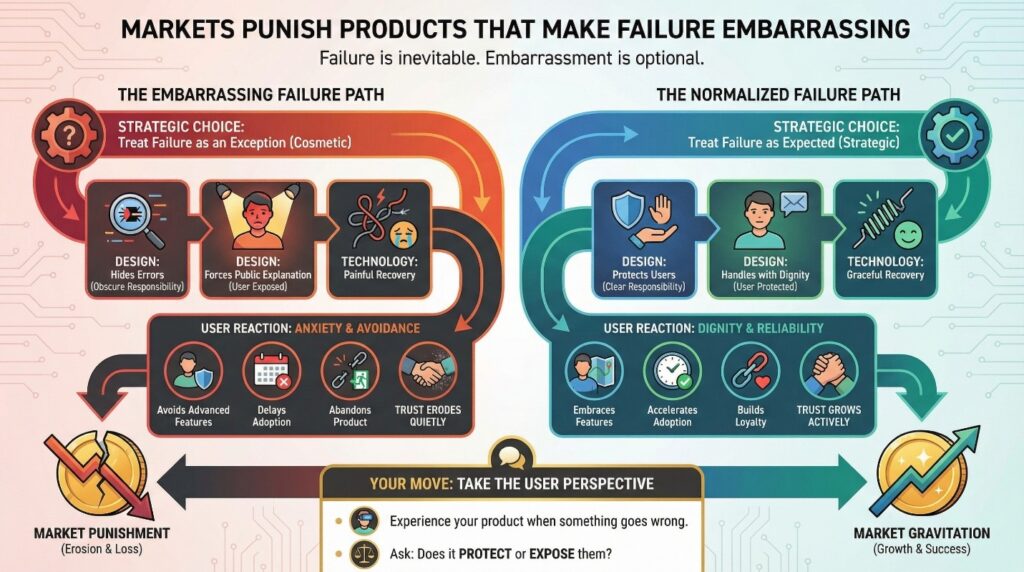
Failure is inevitable. Embarrassment is optional.
Products that hide errors, obscure responsibility, or force users to explain failures publicly create anxiety. Users respond by avoiding advanced features, delaying adoption, or abandoning the product altogether. Trust erodes quietly.
This dynamic is strategic, not cosmetic. Strategy defines whether failure is treated as an exception or an expected condition. Product design either protects users when things go wrong or exposes them. Technology determines whether recovery is graceful or painful.
Markets gravitate toward products that normalize failure and handle it with dignity. Reliability is not perfection; it is recovery.
Your move: Experience your product as a user when something goes wrong. Ask whether it protects or exposes them.
What do you think? Please share your thoughts. If you like our content, pass it on to your colleagues and share it on social media.
Know of any tips about which companies and Topics we should cover next? Send over your suggestions.