
You are selected to receive the Stratagems Newsletter. If you like our content, please support us by sharing and reposting on your social networks and by becoming a paid subscriber. Please subscribe to Stratagems.
https://www.stratagems.info/subscription
Stratagems Newsletter Issue 5
In This Issue:
Stratagems Atlas: Intel’s Fall and Potential Path for Recovery. A Downloadable Report.
Wit and Wisdom Visually – Building on Fads.
Stratagems Atlas:
Can a Fallen Titan Rise Again: Intel’s Strategic Path to Recovery
Download a ~43-page Strategic Analysis of Intel. Read More about the Report below. You are invited to sample Stratagem.Info’s in-depth analysis and reports.
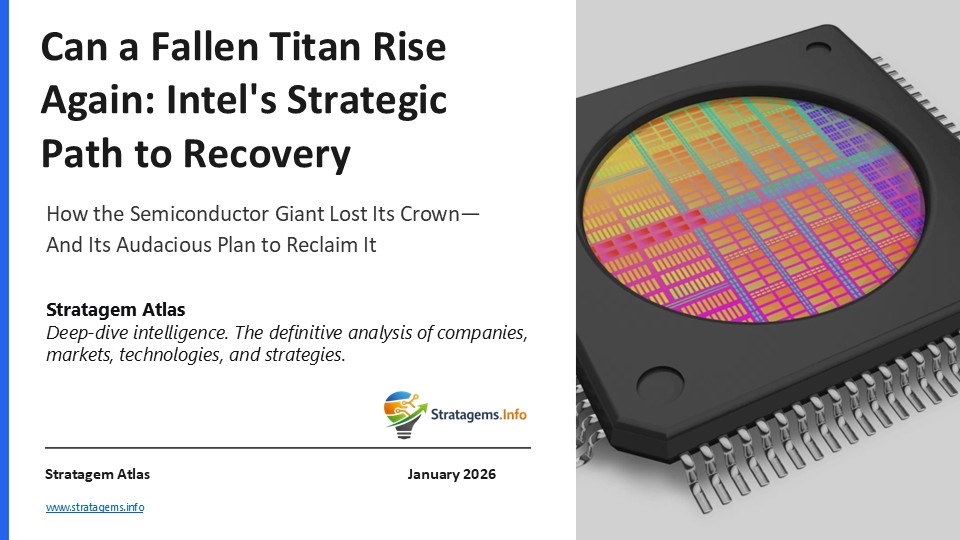
Can Intel Reclaim Its Crown? The $100B Question Facing the Semiconductor Giant
Intel—the name once synonymous with computing dominance—now faces its most existential crisis. After missing the mobile market, stumbling into manufacturing, and losing ground to AMD, NVIDIA, and ARM, the company that defined the PC era is executing the most audacious turnaround attempt in semiconductor history.
The Fall: Intel’s market share cratered from 90%+ in servers to 60-65% as competitors leveraged TSMC’s flawless execution while Intel’s 10nm node was delayed for years. The company that invented the “tick-tock” cadence watched NVIDIA capture AI’s future, AMD resurrect itself with chiplets, and Apple prove ARM could match x86 performance at a fraction of the power. Cultural complacency, manufacturing myopia, and strategic blindness turned market leadership into a fight for survival.
The Gambit: Intel’s response? “5 Nodes in 4 Years”—a manufacturing renaissance combined with building a foundry business from scratch to compete with TSMC. It’s not one bet but two simultaneous existential pivots, either of which alone would be the most ambitious semiconductor turnaround ever attempted. The strategy requires flawless execution on the revolutionary 18A node while convincing competitors like NVIDIA and Qualcomm to trust Intel as their manufacturer.
The Stakes: With $25-30B in annual capital investment, an $18.8B net loss in 2024, and negative free cash flow, Intel has no financial buffer. The following 18-24 months will determine everything. Success could restore balance to the global semiconductor ecosystem and break TSMC’s manufacturing monopoly. Failure could trigger a breakup, leading to America losing its only commercially viable leading-edge chip manufacturer.
This isn’t just a corporate story—it’s a referendum on whether the Integrated Device Manufacturer model can survive in a world that has moved to specialized fabless design. Intel’s transformation from IDM to “Integrated Systems Foundry” is a 50-50 proposition: survival is likely, but dominance is not.
Read the complete strategic analysis to understand the competitive dynamics, financial underpinnings, technical execution risks, and three divergent scenarios that will reshape the semiconductor industry through 2030.
Wit and Wisdom Visually:
Building on Fads
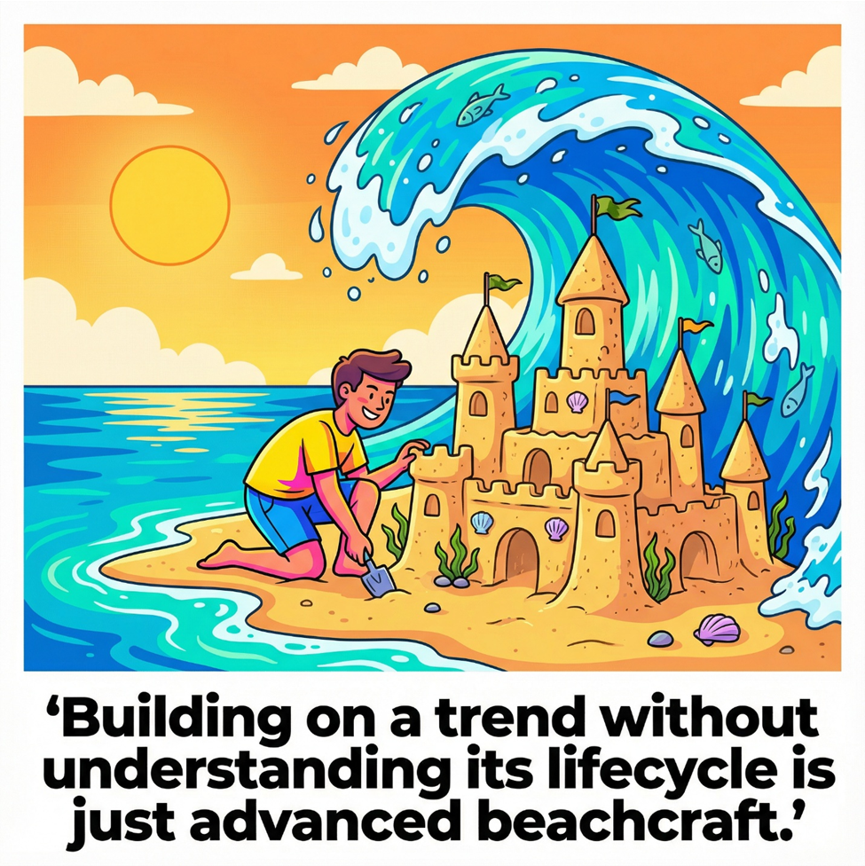
Every boardroom has seen this play: Leadership spots an emerging trend, mobilizes resources, launches an initiative—and within eighteen months, the market has moved on while the organization is still building.
The sandcastle metaphor isn’t about avoiding trends. It’s about understanding their lifecycle before you commit capital and credibility. Too many digital strategies treat “what’s hot now” as if it’s “what will matter forever.” The result? Beautifully constructed initiatives that the market tide sweeps away before they deliver value.
Consider the rush to blockchain in 2017, the metaverse investments of 2021, or the generative AI land grab of 2023. Some organizations built for the wave. Others built for the aftermath. The difference wasn’t timing—it was strategic intent.
Smart leaders distinguish between riding a trend and building on one. Riding means capturing short-term value while the window is open. Building means making structural bets that only pay off if the trend becomes permanent infrastructure. Both can be valid. Mixing them up is expensive.
The framework that works: Map the trend lifecycle before you map the initiative roadmap. Is this technology in its experimental phase, its growth phase, or its maturity phase? Are you making a learning investment, a positioning play, or a transformation bet? Does your timeline account for the reality that today’s breakthrough becomes tomorrow’s table stakes—or tomorrow’s cautionary tale?
The organizations that win don’t avoid trends. They engage with intellectual honesty about what they’re building and why. Sometimes that means riding the wave for quick capability gains. Sometimes that means waiting for the tide to settle before making permanent investments.
Either way, they’re not surprised when the water recedes.
What do you think? Please share your thoughts. If you like our content, pass it on to your colleagues and share it on social media.
Know of any tips about which companies and Topics we should cover next? Send over your suggestions.