
You are selected to receive the Stratagems Newsletter. If you like our content, please support us by sharing and reposting on your social networks and by becoming a paid subscriber, please subscribe to Stratagems.
https://www.stratagems.info/subscription
Stratagems Newsletter Issue 6
In This Issue:
Stratagems Atlas: The Asymmetric Strategy
Wit and Wisdom Visually – Product Coherence
Stratagems Nexus:
The Asymmetric Strategy
Download the Artifacts:
📋 Asymmetric Value Curve Worksheet – Maps where incumbents over-serve (eliminate features) and under-protect (dominate neglected dimensions). ERRC Grid + Zugzwang Test validate responses worsen their position.
🎯 Blind Spot Validation Interview Guide – Structured interviews validating structural constraints vs. temporary gaps. Screening questions, scorecards, Proceed/Pivot/Pause frameworks.
Why did Adobe pay $1.275 billion for Frame.io? Not because Frame.io built better video collaboration. They won because Adobe couldn’t fight back without destroying their own fortress.
This is asymmetric strategy—how David actually beats Goliath.
Most founders obsess over what they build better. That’s backwards. The real question: What would destroy the incumbent to even try?
Dollar Shave Club launched $1 razors by mail. Gillette faced zugzwang—every move worsened their position. Lower prices? Cannibalize 70% market share. Ignore it? Cede the channel. Launch subscriptions? Undermine retail driving 90% of revenue. Choosing between bad and worse.
Stratagems just published “The Asymmetric Strategy Canvas,” a framework for identifying where entrenched competitors cannot respond, even seeing you coming.
Three structural cages trap every market leader:
→ Revenue Architecture Lock-In (Salesforce dismissed Slack until $900M ARR, then paid $27.7B)
→ Customer Promise Handcuffs (Oracle couldn’t match MongoDB’s speed without betraying their proposition)
→ Organizational Scar Tissue (Windows Server delayed Microsoft’s cloud response, gifting AWS the kingdom)
The Canvas maps Incumbent Investment Intensity vs. Market Evolution Velocity to reveal the kill zone: where markets evolve faster than incumbents can organizationally respond.
Two battle-tested artifacts:
📋 Asymmetric Value Curve Worksheet – Maps where incumbents over-serve (eliminate features) and under-protect (dominate neglected dimensions). ERRC Grid + Zugzwang Test validate responses worsen their position.
🎯 Blind Spot Validation Interview Guide – Structured interviews validating structural constraints vs. temporary gaps. Screening questions, scorecards, Proceed/Pivot/Pause frameworks.
The insight: Your advantage isn’t what you do better—it’s what incumbents cannot do without violating the logic that made them successful.
Zoom changed buying from IT procurement to individual adoption. Cisco’s enterprise model became their cage.
Tesla’s vertical integration scales while Ford’s dealers became liabilities. More Mach-E = more dealer tension.
The article covers implementation protocol, war-gaming responses, Frame.io/Netflix/Toast/Slack cases, and three fatal pitfalls.
This inverts strategy: change the game so their strengths become weaknesses and muscle memory becomes paralysis.
Find where giants’ armor has gaps they cannot close without removing the armor.
The question isn’t whether giants can be beaten—it’s whether you can identify the battle they cannot fight without fighting themselves.
That’s an asymmetry worth building a company around
Wit and Wisdom Visually:
Product Coherence
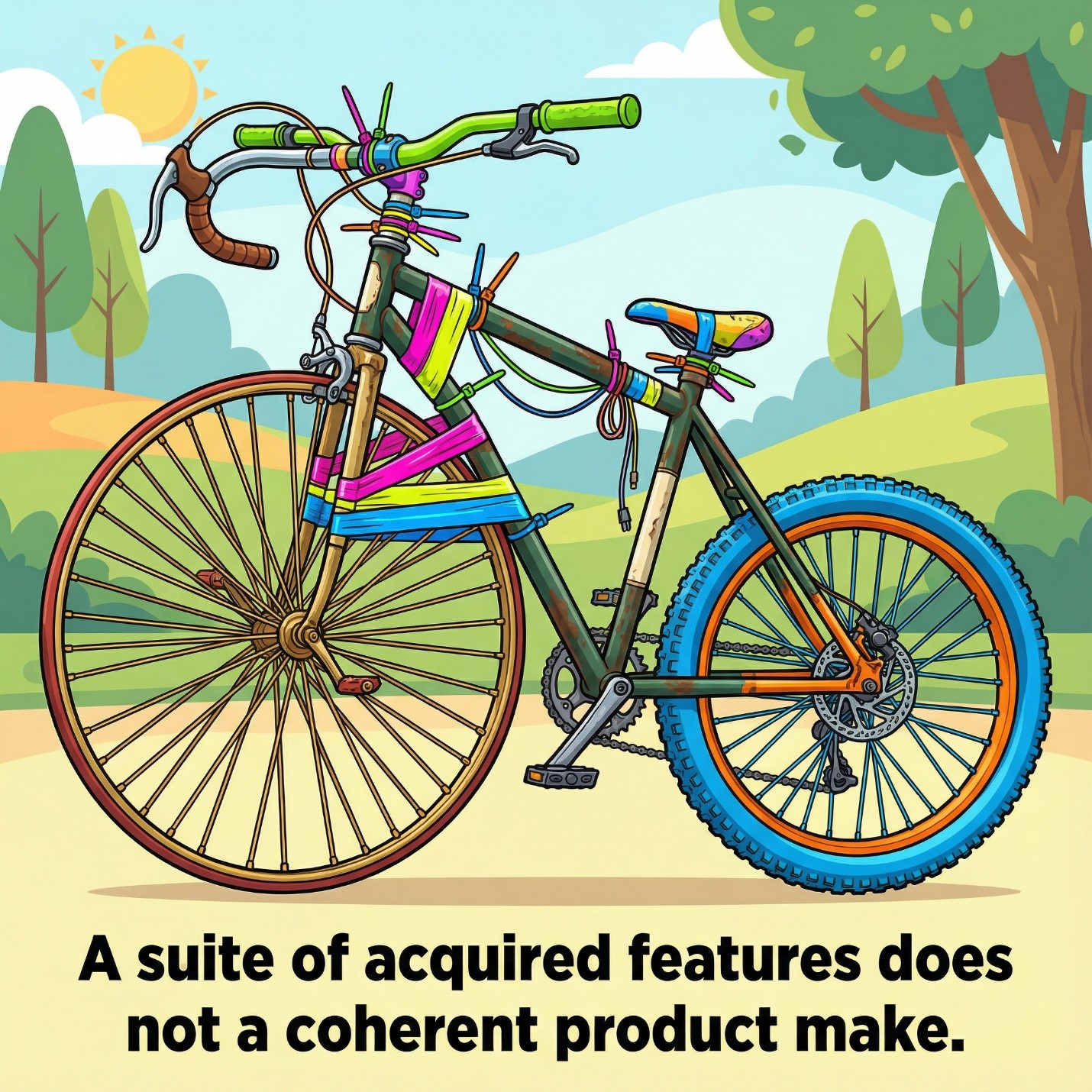
The M&A presentation looked perfect. Three acquired companies with complementary capabilities. A portfolio of best-in-class features. A “suite” that, on paper, covered every customer need.
Eighteen months later, the integration team was still trying to make the login systems talk to each other. Customers were maintaining three separate accounts. Sales was discounting heavily because nobody could explain how the pieces fit together.
Acquisition is easy. Integration is hard. Coherence is nearly impossible without architectural intent.
The bicycle built from mismatched parts is every technology portfolio that grew through opportunistic addition rather than strategic design. The front wheel spins differently than the back. The gears don’t match the chain. Every component works individually. Nothing works together. And the rider—your customer—is left trying to make sense of something that should have been designed as a system.
This isn’t just an M&A problem. It’s the natural outcome of feature-driven development, point-solution purchasing, and departmental autonomy. Marketing buys a tool. Sales buys a different tool. IT integrates both. Customers experience neither as coherent.
The organizations that break this pattern do three things well: They design at the system level before they build at the feature level. They establish architectural principles that govern what gets added and how. And they regularly prune—removing capabilities that don’t serve the coherent whole, even when those capabilities work perfectly in isolation.
The question every leadership team should ask quarterly: Are we building a product or accumulating features? Because the market can tell the difference, even when your roadmap can’t.
What do you think? Please share your thoughts. If you like our content, pass it on to your colleagues and share it on social media.
Know of any tips about which companies and Topics we should cover next? Send over your suggestions.