
You are selected to receive the Stratagems Newsletter. If you like our content, please support us by sharing and reposting on your social networks and by becoming a paid subscriber, please subscribe to Stratagems.
https://www.stratagems.info/subscription
Stratagems Newsletter Issue 7
In This Issue:
Stratagem Trailblazers – Notion: The LEGO Blocks of Software. A Downloadable Report.
Good Reads – Blue Ocean Strategy
Strategy Signals – Competitive Advantage Comes from Making Fewer Things Important
Stratagem Trailblazers:
Stratagem Trailblazers: Notion – The LEGO Blocks of Software
Download a ~20-page Analysis of a Trailblazer. Read More about the Report below. You are invited to sample Stratagem.Info’s in-depth analysis and reports.
Notion: How Two Founders Hid a Programming Language Inside a Notes App—And Built an $11B Company
What if the secret to disrupting productivity software wasn’t building something radically new, but hiding radical power inside something comfortingly familiar?
In 2013, Ivan Zhao and Simon Last launched Notion as a developer tool. Nobody cared. By 2015, their tech stack had collapsed, they had run out of cash, and the dream seemed dead. So they did something counterintuitive: they fired their team, moved to Kyoto, and rebuilt everything from scratch around a single architectural insight—everything is a block.
The “Sugar-Coated Broccoli” Strategy: Zhao’s philosophy was simple: “People don’t want to eat broccoli. But if you hide the broccoli in sugar, they’ll eat it.” Translation? Users want results, not tools. So Notion disguised a powerful database builder and programming environment as a simple note-taking app. You came for the notes. You stayed because you discovered you could build custom CRMs, project trackers, and entire business operating systems—without writing code.
The LEGO Effect: By treating every piece of information as an atomic, interchangeable “block,” Notion created infinite flexibility. A paragraph could become a task. A task could become a database entry. A database could nest inside a document. The more users built, the harder it became to leave—classic IKEA Effect retention.
Zero-Dollar Growth Engine: Notion spent $0 on advertising but recruited 200,000+ community ambassadors. Power users built templates, sold them as products, and became a distributed sales force. The “Duplicate” button turned every user into a distributor. By the pandemic, when remote work exploded, Notion was perfectly positioned as the async headquarters for distributed teams.
The AI Timing Coup: Two weeks before ChatGPT launched, Notion quietly released Notion AI—integrated directly into the editor where work happens. While competitors bolted chatbots onto sidebars, Notion made AI write with you. Result? 50%+ paid adoption rate.
The Valuation Discipline: In 2021, Notion raised at a $10B valuation on just $31M in revenue (322x multiple). Instead of chasing another round, they grew revenue 20x while valuation stayed flat—turning an inflated ZIRP bet into legitimate public-company fundamentals.
Discover the full strategic playbook behind one of the most disciplined, community-driven product transformations in tech history—and what it teaches about patience, misdirection, and category creation.
Good Reads:
Blue Ocean Strategy

by W. Chan Kim and Renée Mauborgne
Introduces the strategy canvas and value innovation framework for creating uncontested market space rather than competing in bloody red oceans.
Strategy Signals:
Competitive Advantage Comes from Making Fewer Things Important
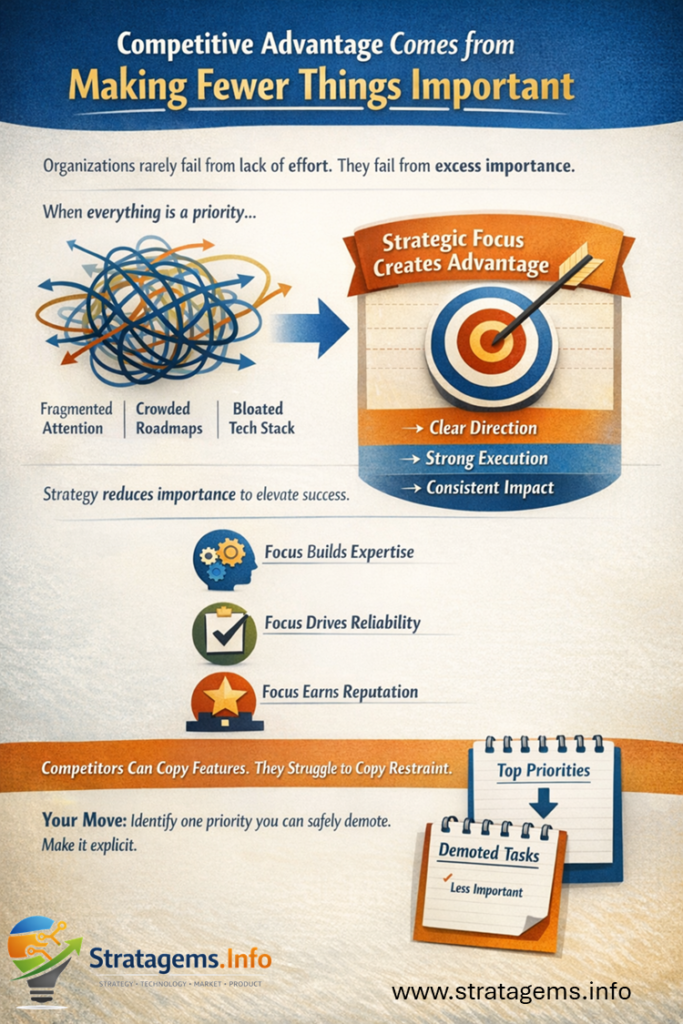
Organizations rarely fail because of a lack of effort. They fail from excess importance.
When too many priorities matter equally, attention fragments. Tradeoffs stall. Product roadmaps become crowded. Technology stacks swell. Markets experience inconsistency.
Strategy creates an advantage by reducing the importance of many things to a few. It declares some things peripheral so others can dominate. This reduction is not neglect—it is focus. Over time, focus compounds into expertise, reliability, and reputation.
Competitors can copy features. They struggle to copy restraint.
Your move: Identify one priority you can safely demote. Make that demotion explicit.
What do you think? Please share your thoughts. If you like our content, pass it on to your colleagues and share it on social media.
Know of any tips about which companies and Topics we should cover next? Send over your suggestions.