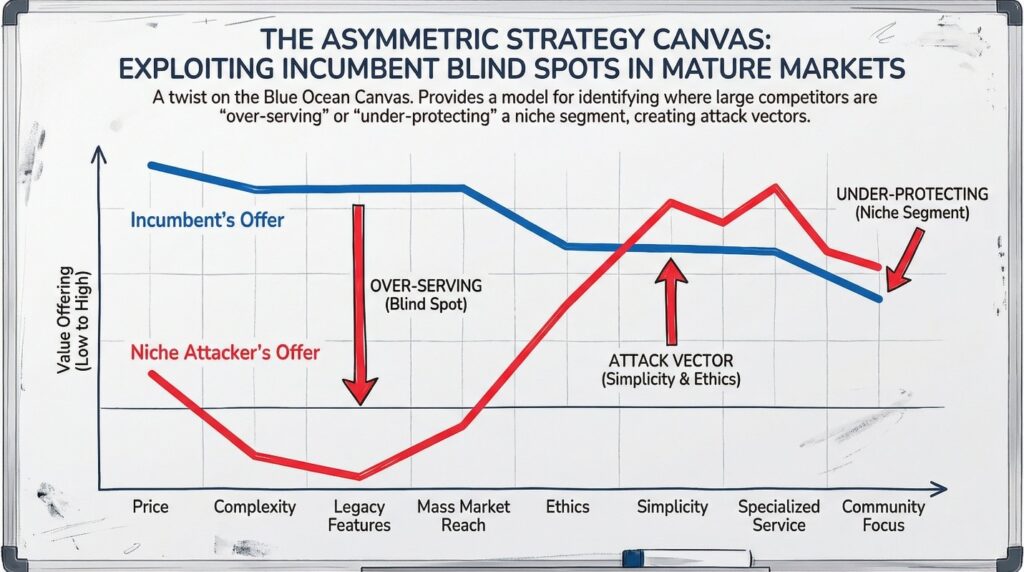

The Calculated Contrarian Matrix: A Tool for Systematic, Low-Risk Rebellion
Most strategic differentiation dies in committee meetings. Not because the ideas lack merit, but because they’re defended with passion rather than precision. A product leader proposes bucking industry convention—say, eliminating a feature every competitor offers, or doubling down on a segment everyone else abandoned—and the room divides. Advocates lean on gut instinct (“customers will love this”); skeptics invoke best practices (“there’s a reason everyone does it this way”). Without a shared framework for evaluating contrarian moves, the bold idea either gets watered down into irrelevance or greenlit based on whoever argues loudest.
Here’s the uncomfortable truth: being different for difference’s sake is a vanity project. But reflexively following industry orthodoxies guarantees you’ll compete on the same tired dimensions as everyone else—price, speed, feature count—where margins erode, and customers see you as interchangeable. The companies that dominate niches don’t just zig when others zag. They develop a systematic method for identifying which orthodoxies are ripe for challenge and which customer sacrifices are worth addressing.
That method is the Calculated Contrarian Matrix.
Download the Artifacts:
Rebellion Risk Register
Contrarian Hypothesis Evaluation Matrix
The Rebellion Paradox
In 2007, Netflix mailed DVDs to 7.5 million subscribers. Blockbuster had 9,000 stores. The orthodoxy was ironclad: customers want instant gratification, which meant physical retail locations. Netflix’s bet—that customers would accept a two-day delay for unlimited selection and no late fees—looked absurd. Blockbuster’s CEO famously passed on acquiring Netflix for $50 million, calling their model a “very small niche business.”
The orthodoxy was wrong. But here’s what’s instructive: Netflix didn’t challenge the instant gratification orthodoxy by being reckless. They’d tested, measured, and discovered something the industry missed. Customers would sacrifice immediacy, but only if you eliminated other frictions—late fees, limited selection, the trip to the store. They challenged one orthodoxy while addressing a customer sacrifice that everyone else accepted as unavoidable.
Contrast this with the countless “Uber for X” startups that died between 2012 and 2018. They challenged the orthodoxy that certain services required traditional fulfillment models. But they missed the second half of the equation: were customers actually sacrificing anything meaningful in the status quo? Turns out, most people weren’t desperate for on-demand dry cleaning or lawn mowing. The orthodoxy they challenged wasn’t actually constraining customer value.
This is the rebellion paradox. Challenge the wrong orthodoxy, and you’re Don Quixote tilting at windmills. Accept every orthodoxy, and you’re a commodity. The question isn’t whether to be contrarian—it’s how to be contrarian with precision.
Introducing the Calculated Contrarian Matrix
The Matrix plots opportunities along two dimensions:
Vertical Axis: Strength of Industry Orthodoxy
- How deeply entrenched is the conventional wisdom?
- What’s the cost of defying it (ecosystem lock-in, customer education, operational complexity)?
Horizontal Axis: Magnitude of Customer Sacrifice
- How much value are customers leaving on the table because of accepted compromises?
- How acute is the pain point the industry has normalized?
This creates four quadrants, each requiring a different strategic posture:
UPPER RIGHT (High Orthodoxy, High Sacrifice): The Sweet Spot. These are calcified industry beliefs that force customers into meaningful compromises. This is where Netflix lived in 2007. Everyone “knew” video rental required physical stores, yet customers hated late fees and limited inventory. When orthodoxy is strong, but customer sacrifice is equally strong, you’ve found the terrain for market-making moves.
LOWER RIGHT (Low Orthodoxy, High Sacrifice): The Obvious Play. The industry already recognizes the customer pain—there’s just no dominant solution yet. Multiple players are experimenting. This is where you race to execute, not where you need contrarian courage. Think of cybersecurity solutions in 2014: everyone knew perimeter defense was failing (low orthodoxy), and breaches were costing companies billions (high sacrifice). No contrarian positioning needed—just superior execution.
UPPER LEFT (High Orthodoxy, Low Sacrifice): The Fool’s Errand. Strong conventional wisdom exists because customers aren’t actually suffering. Challenging the orthodoxy here is pure ego. Example: the string of startups that tried to “disrupt email” between 2010 and 2020 by building fundamentally different communication paradigms. Email has problems, sure, but the orthodoxy—asynchronous, threaded messages—serves most use cases well enough. The sacrifice isn’t meaningful enough to warrant the switching cost.
LOWER LEFT (Low Orthodoxy, Low Sacrifice): The Distraction. Neither the industry nor customers care. This is where most innovation theater lives—incremental tweaks to things that aren’t broken, presented as breakthroughs. A SaaS company adding a feature customers never requested, justified by “keeping up with competitors.” Zero strategic value.
The Matrix in Action: Basecamp vs. the Project Management Arms Race
In the mid-2000s, project management software followed a clear orthodoxy: more features equal more value. Every release added Gantt charts, resource allocation tools, time tracking, and dependency management. The logic was bulletproof—enterprises need comprehensive solutions.
Basecamp plotted itself on the Matrix and made a counterintuitive call. The orthodoxy was strong (everyone believed feature completeness was table stakes), but they identified a massive customer sacrifice: simplicity. Small teams and agencies were drowning in complexity. They needed 20% of the features but were paying for—and navigating—100%.
Basecamp launched with radically fewer features. No Gantt charts. No resource management. Just discussions, to-dos, and file sharing. Industry analysts predicted they’d be a marginal player. Instead, they built a $100 million business specifically because they occupied the Upper Right quadrant. The orthodoxy was strong, but the sacrifice—cognitive overhead, onboarding friction, wasted features—was equally strong.
Here’s where it gets interesting. Basecamp didn’t stop there. Every few years, competitors would add features Basecamp lacked, and customers would request them. Basecamp would run the Matrix exercise again. Usually, the answer was no—the orthodoxy was strengthening (everyone expects feature X now), but the customer sacrifice remained low (our core users don’t actually need it). Occasionally, they’d spot a new Upper Right opportunity. When mobile work exploded, the orthodoxy said project management required desktop complexity. But remote teams were sacrificing real-time coordination. Basecamp built its mobile app around that specific sacrifice, not feature parity with desktop.
The companies that failed in this space? They either challenged orthodoxies without meaningful customer sacrifice (trying to reinvent basic task management) or addressed minor sacrifices while accepting major orthodoxies (building yet another Gantt chart tool with slightly better UX).
Plotting Your Position: The Diagnostic Process
Using the Matrix isn’t about gut feel—it’s forensic work. Here’s the protocol:
Step 1: Inventory the Orthodoxies. Gather your team and list what “everyone knows” about your market. Not trends or preferences, but bedrock beliefs. In B2B SaaS, an orthodoxy might be “enterprise customers require on-premise deployment” or “seats-based pricing is the only scalable model.” In consumer hardware, it’s “flagship products need annual refresh cycles.” Write them down. You’ll be surprised how many go unquestioned.
Step 2: Validate the Strength. For each orthodoxy, ask:
- What percentage of competitors follow this belief?
- What’s the ecosystem reinforcement? (Analyst reports, conference themes, VC pattern matching)
- What would it cost us to defy it? (Technical replatforming, customer education, channel conflict)
Score each as High, Medium, or Low orthodoxy strength. Be honest. If only 60% of competitors do something, it’s not an orthodoxy—it’s just common.
Step 3: Map the Sacrifices. For each orthodoxy, identify what customers accept as a necessary evil. This requires actual customer research, not speculation. Conduct jobs-to-be-done interviews. Analyze support tickets. Watch user sessions. The question isn’t “what do customers want?” but “what compromises are they making because they assume there’s no alternative?”
Rate each sacrifice by:
- Frequency: How often does the pain occur?
- Severity: What’s the impact when it does?
- Awareness: Do customers recognize it as a problem, or have they normalized it?
A sacrifice that’s frequent, severe, and unrecognized is platinum. One that’s rare and mild is noise.
Step 4: Plot and Prioritize Map your orthodoxies onto the Matrix. You’re looking for clustering in the Upper Right. Those are your calculated contrarian opportunities. But here’s the critical part: you can’t chase all of them. Pick one, maybe two, where:
- You have a credible capability to deliver the alternative
- The sacrifice aligns with your core customer segment’s priorities
- The timing is right (adjacent technologies, regulatory changes, or generational shifts make the challenge viable)
Step 5: Stress Test the Contrarian Move. Before committing, run three tests:
The Switching Cost Reality Check: Even if customers hate the sacrifice, will they switch? Netflix worked because the subscription model had low trial friction. If your solution requires ripping out infrastructure or retraining teams, the sacrifice needs to be absolutely excruciating to justify the switch.
The Ecosystem Alignment Test: Does your contrarian position require partners to change, or can you execute independently? Amazon’s AWS challenged the orthodoxy that enterprises need owned data centers. But they didn’t need data center vendors to cooperate—they built the alternative themselves.
The Durability Assessment: Is this orthodoxy weakening on its own? If trend lines show the belief is already crumbling, you’re not being contrarian—you’re being late. The best opportunities are orthodoxies that look more entrenched over time but are actually brittle.
When the Matrix Fails: Pitfalls and Edge Cases
The Matrix is powerful, but it’s not foolproof. Three failure modes to watch for:
Confusing Vocal Minorities for Customer Sacrifice. Power users, early adopters, and online communities amplify certain pain points that aren’t representative. In 2010, photography enthusiasts demanded phone cameras with optical zoom. Seemed like a real sacrifice. But the mass market didn’t care—computational photography and social sharing mattered more. Nokia built cameras with Zeiss optics while Apple built Instagram-optimized sensors. Validate sacrifice magnitude with behavioral data, not forum threads.
Overestimating Your Ability to Educate the Market: Challenging a strong orthodoxy means fighting customer preconceptions. Tesla could do it because they had Elon Musk’s platform, billions in capital, and a product so different that it created its own category. Most companies don’t have that luxury. Suppose your contrarian move requires a multi-year educational campaign, factor that cost into the equation. Sometimes the sacrifice is real, but the market isn’t ready.
Ignoring Second-Order Effects You challenge an orthodoxy and address a sacrifice—great. But what new sacrifices does your solution create? Airbnb eliminated the sacrifice of hotel pricing and stale inventory by challenging the orthodoxy that lodging requires professional hospitality. But they created new sacrifices around trust, consistency, and local regulation. They anticipated this and built verification systems. If you don’t map second-order sacrifices, your contrarian move might just trade one pain point for another.
The Discipline of Strategic Heresy
The Calculated Contrarian Matrix isn’t permission to be reckless. It’s a tool for making rebellion systematic. The companies that dominate their niches don’t follow every orthodoxy, but they don’t challenge all of them either. They develop the discipline to identify precisely where conventional wisdom is both strong and wrong—and where customer sacrifices are both real and addressable.
Start by mapping your market’s orthodoxies this week. You’ll notice something immediately: most are defended with circular logic (“we do it this way because everyone does it this way”). That’s your opening. But don’t stop there. Validate the customer sacrifice with data, not instinct. Plot your options. Stress test your assumptions.
The future belongs to companies that can be strategically deviant—different in ways that matter, orthodox in ways that don’t. The Matrix gives you the scaffolding to know the difference. Because in a world of feature parity and price wars, the only sustainable differentiation comes from challenging beliefs everyone else takes as gospel.
Just make sure they’re the right beliefs.
Sources & Further Reading:
- Christensen, Clayton M. The Innovator’s Dilemma: When New Technologies Cause Great Firms to Fail. Harvard Business Review Press, 1997. (Foundational text on orthodoxy disruption through disruptive innovation)
- Keeley, Larry et al. Ten Types of Innovation: The Discipline of Building Breakthroughs. Wiley, 2013. (Framework for systematic innovation, including business model and process innovations)
- Fried, Jason, and David Heinemeier Hansson. Rework. Crown Business, 2010. (Basecamp founders’ philosophy on challenging software industry orthodoxies)
- Netflix Q4 2007 Earnings Report and Blockbuster historical financials (publicly available via SEC filings and investor relations archives)
- Moore, Geoffrey A. Crossing the Chasm. HarperBusiness, 1991. (Classic analysis of market adoption dynamics relevant to understanding customer sacrifice awareness)